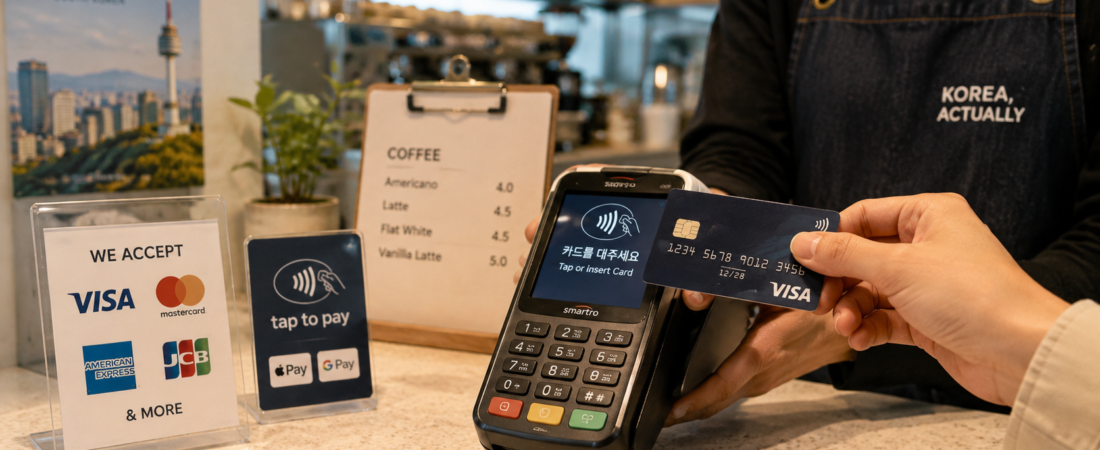
Yes. Foreign credit cards are widely usable in Korea, especially Visa and Mastercard.
At hotels, department stores, convenience stores, restaurants, cafés, and many other businesses, paying by card is part of everyday life.
But there is one important catch: a foreign card that works perfectly at a store may not work for every type of payment in Korea.
The biggest differences tend to show up with transportation, certain online payments, and services designed around Korean payment systems.
Where Can You Use a Foreign Credit Card in Korea?
For everyday purchases, using a foreign card is usually straightforward.
You can generally expect card payments at places such as:
- Hotels
- Department stores and shopping malls
- Convenience stores
- Supermarkets
- Restaurants and cafés
- Tourist attractions
- Many taxis
Visa and Mastercard are the safest cards to bring because of their broad acceptance.
That said, carrying a second payment option is still a good idea. A particular card or transaction can occasionally fail even when the business accepts cards.
Where Can Things Get Complicated?
The more important distinction in Korea isn’t simply “card or cash.”
It’s often “Korean-issued card or foreign-issued card.”
Some Korean online services and payment systems are designed around locally issued cards, Korean phone numbers, or domestic identity verification.
That means you may encounter situations where a foreign card isn’t accepted even though the service itself accepts credit cards.
This is particularly worth remembering when making online purchases or using Korean apps.
What About Public Transportation?
This is where things work differently.
For ordinary subway and bus travel, don’t assume you can simply tap your foreign credit card at the gate or card reader.
A Korean transportation card such as Tmoney is still one of the easiest options for getting around. Tmoney and similar prepaid transportation cards can be purchased at convenience stores and used across public transportation.
There are some important exceptions.
In Seoul, newer ticket machines on subway Lines 1–8 accept internationally issued cards such as Visa and Mastercard for single-journey tickets and short-term Climate Cards. This service began in March 2026.
So the simple rule is: foreign cards can now be used for more transit-related purchases, but don’t rely on your regular foreign credit card as your everyday transit card.
Should You Carry Cash?
Yes — but you probably don’t need a huge amount.
Korea is highly card-oriented, so cash doesn’t need to be your main payment method. A small amount of Korean won is useful as a backup, particularly for situations involving transportation cards or places where your foreign card doesn’t work.
One useful example is Tmoney: current guidance says standard Tmoney purchases and top-ups may require cash rather than a foreign-issued credit card.
The Easiest Payment Setup
You don’t need to overcomplicate this.
A simple combination of cards, a transportation card, and a little cash will cover most everyday situations.
- Your main international credit or debit card
- A second card as a backup
- A transportation card such as Tmoney
- A small amount of Korean won
With those four things covered, you should be prepared for most everyday payment situations in Korea.
The Bottom Line
Yes, you can use a foreign credit card in Korea for many everyday purchases.
The main thing to remember is that some transportation services, online payments, and locally focused payment systems can work differently.
Bring your main card, a backup card, a transportation card, and a little cash, and you’ll be ready for most everyday situations.
New to Korea? Korea, Actually explains the practical things about Korea that are surprisingly difficult to find clear answers to.