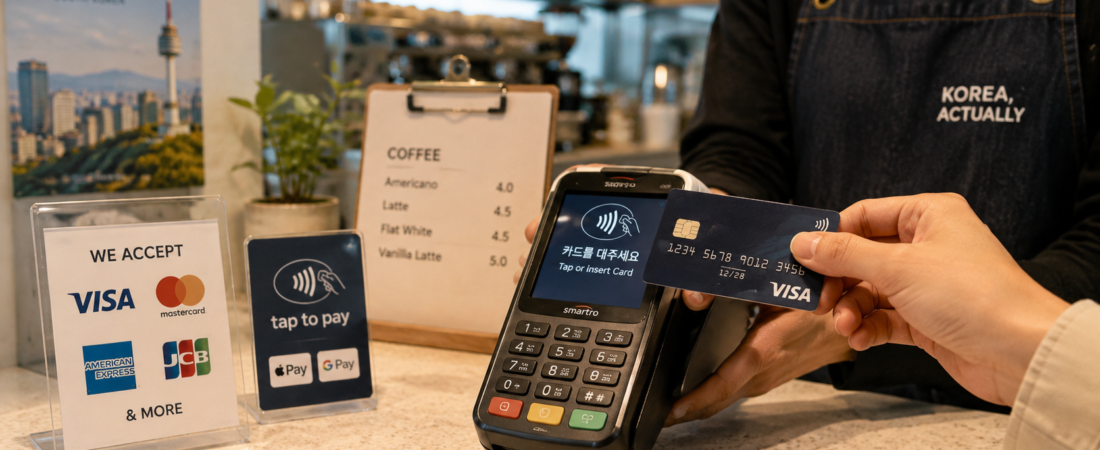
Yes. Foreign-issued credit cards are generally accepted for ordinary in-person payments in Korea.
Hotels, department stores, convenience stores, restaurants, cafés, taxis, and many other traveler-facing businesses commonly accept card payments.
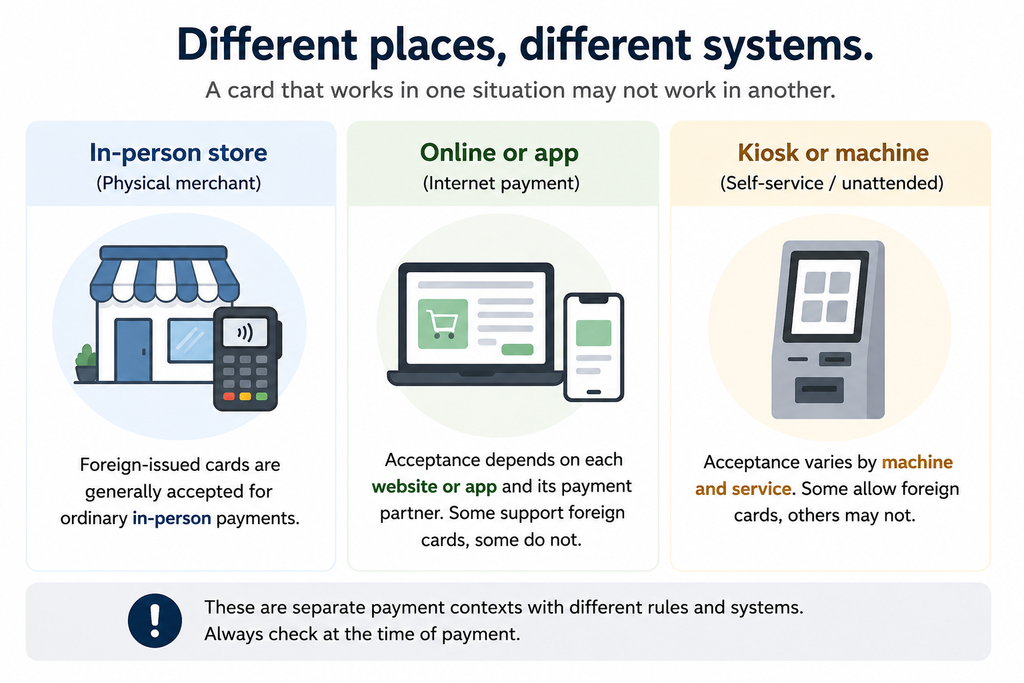
The main thing to know is that a card that works at a physical store may not work in every Korean app, website, kiosk, or transportation system. Acceptance can depend on the merchant, machine, service, and your own card issuer.
Where do foreign credit cards usually work?
For ordinary in-person purchases, trying your foreign card first is a reasonable default.
Current visitor guidance confirms foreign-issued card support across many common travel payments, including major rail ticketing, express and intercity bus ticketing, taxis, rental-car services, and some newer subway ticket machines.
That does not mean every merchant or machine accepts every overseas card. A transaction can still fail because of the terminal, service, card network, or issuer.
If possible, travel with a second payment option rather than relying on one card for everything.
Why can a card work in a store but fail online?
In-person card acceptance and Korean online or app payments are not the same thing.
Some local websites, reservation systems, or apps may not accept international cards even when the same foreign card works normally at a physical merchant.
Some services provide a separate global or foreigner-facing payment flow that supports overseas-issued cards.
If your card fails in a Korean app or website, do not assume the card is unusable in Korea. Check whether that service offers an international-user version or another supported payment method.
Kiosks and unattended machines vary too: some accept foreign cards and some do not.
What should you do if tap or card payment fails?
Contactless payment depends on the terminal.
If tapping your physical card does not work, try inserting the chip if the terminal accepts card payments.
If the transaction is declined:
- Try the card again using the terminal’s supported method.
- Try another card if you have one.
- If repeated transactions are declined, check your card issuer’s overseas-use or security settings.
- If the machine or service itself does not accept foreign cards, switch to an international-user payment channel or another supported payment method.
- Use backup Korean won if necessary.
Before traveling, it is also worth checking that your card is enabled for overseas use and that you understand any issuer-specific limits or security controls.
A decline does not automatically mean that foreign cards are not accepted in Korea.
What about transportation, cash, and currency conversion?
Do not assume that an ordinary foreign credit card can be tapped directly at every subway or bus gate.
Foreign cards are accepted for many transport-related purchases, but direct transit use and prepaid transportation-card systems follow their own rules.
For regular transportation-card use, see How to Buy and Use a Tmoney Card in Korea: A Simple Guide.
Keeping a small amount of Korean won as backup is also useful when a merchant, machine, or service does not accept your card. For when cash is actually useful, see Do You Need Cash in Korea?.
If you need to withdraw Korean won, use an ATM that supports your card’s international network. The withdrawal process is covered in How to Withdraw Cash from an ATM in Korea with a Foreign Card.
Finally, a card terminal or ATM may sometimes offer to charge you in your home currency instead of Korean won. This is Dynamic Currency Conversion (DCC).
If you are offered a choice between your home currency and KRW, check the conversion carefully. Paying in KRW avoids the merchant or ATM’s DCC conversion and leaves currency conversion to your card network or issuer.