Ordering food in Korea is usually easier than it first appears.
Many restaurants have simple ordering systems, and once you understand a few common habits, the whole experience becomes much more comfortable.
The main things to know are how to place your order, how to get a staff member’s attention, what to expect from side dishes, and where to pay when you are finished.
This guide explains the basics so you can walk into a Korean restaurant with a better idea of what to expect.
How Do You Order Food in Korea?
The ordering process depends on the restaurant.
In many traditional or casual restaurants, a staff member will take your order at the table. Other restaurants use a tablet at the table, a self-service kiosk, or a counter where you order before sitting down.
If the menu is only in Korean, photos can help, and a translation app can be useful for unfamiliar dishes.
In restaurants where staff take your order, you can usually point to an item on the menu if you are unsure how to pronounce its name.
Once you know which ordering system the restaurant uses, the rest is usually straightforward.
How Do You Get a Staff Member’s Attention?
In many Korean restaurants, you do not need to wait for a server to check on your table.
Some restaurants have a call button on the table. Pressing it lets the staff know that you need assistance.
If there is no call button, it is common to get a staff member’s attention by saying “Jeogiyo” (저기요), which is similar to saying “Excuse me.”
This can feel unusual if you are used to restaurants where servers regularly come back to the table, but in Korea it is a normal part of the dining experience.
You do not need to raise your voice loudly — just speak clearly enough for the staff to hear you.
What Are the Side Dishes?
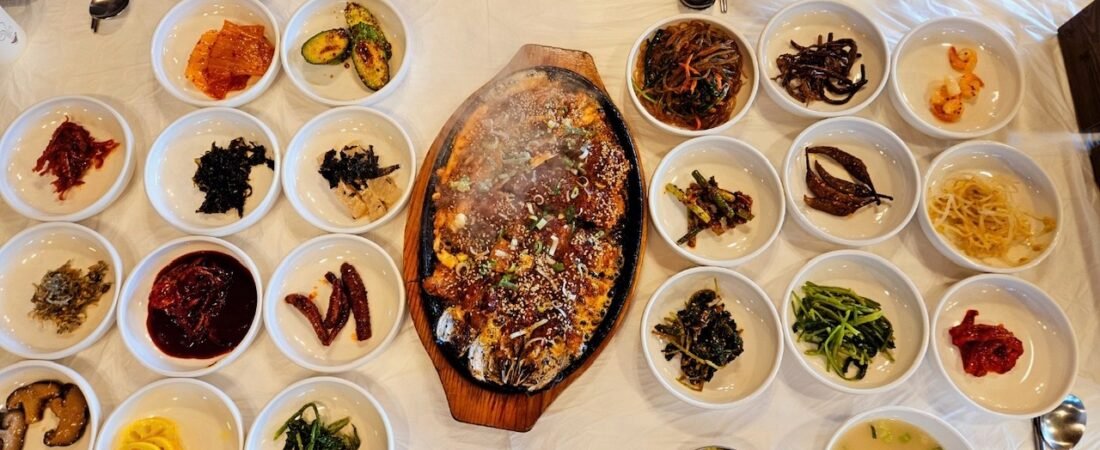
Many Korean meals come with small side dishes called banchan (반찬).
These can include kimchi, vegetables, pickled dishes, and other small items that are served alongside the main meal.
In many restaurants, basic side dishes are included with the meal rather than charged separately.
Some restaurants may also refill certain side dishes if you ask, although this can vary depending on the restaurant and the dish.
If you are unsure whether something is included or costs extra, it is perfectly fine to ask before ordering more.
Do You Share Food in Korea?
Some Korean dishes are meant to be shared, while others are served as individual meals.
Large dishes such as Korean barbecue, hot pot, or some stews are often placed in the center of the table for everyone to share.
At the same time, many meals — such as rice bowls, noodle dishes, or soups — are served individually.
If you are sharing food, restaurants often provide small plates or bowls so each person can take a portion.
You do not need to worry about knowing every dining custom in advance. Just follow the way the food is served and you will usually be fine.
How Do You Pay at a Korean Restaurant?
In many Korean restaurants, you pay at the counter when you are ready to leave rather than waiting for the bill at your table.
Some restaurants may leave a small order slip or table number at your table. If so, take it with you to the counter when you pay.
Other restaurants use self-service kiosks or allow payment directly at the table, so the exact process can vary.
Credit and debit cards are commonly accepted, but having another payment option available can still be useful.
If you are unsure where to pay, simply watch what other customers do or ask a staff member.
Do You Need to Tip in Korea?
Tipping is generally not expected in Korea.
At most restaurants, cafés, and casual dining places, you simply pay the amount shown on the bill.
There is usually no need to calculate an additional percentage or leave cash on the table.
Some hotels or higher-end services may handle gratuities differently, but for everyday restaurants, tipping is not part of the normal dining routine.
If you receive good service, a polite thank you is more than enough.
A Few Useful Restaurant Tips
A few small details can make dining in Korea much easier.
- Water is often self-service, especially at casual restaurants.
- Some restaurants also have a self-service area for extra side dishes, utensils, or napkins.
- Chopsticks and spoons may be inside a drawer built into the table rather than placed on top.
- At barbecue restaurants, staff may help cook the meat, while at others you may cook it yourself.
- Some restaurants have minimum-order rules for certain dishes, especially meals designed for sharing.
If something is unclear, do not worry. Restaurant systems vary, and staff are generally used to customers asking simple questions.
The Easiest Way to Handle Your First Meal
You do not need to memorize Korean dining etiquette before walking into a restaurant.
For your first meal, simply check how the restaurant takes orders, choose what you want from the menu, and follow the system being used.
If there is a call button, use it when you need help. If there is not, saying “Jeogiyo” is usually enough to get a staff member’s attention.
Enjoy the side dishes that come with your meal, and when you are finished, check whether payment is made at the table or at the counter.
After one or two meals, most of these routines will start to feel completely normal.
The Bottom Line
Ordering food in Korea is usually simple once you understand a few basic restaurant habits.
Check how the restaurant takes orders, use the call button or say “Jeogiyo” when you need help, enjoy the side dishes that come with your meal, and look for the counter when it is time to pay.
You do not need to know every dining custom before your first meal. After a few restaurant visits, most of the process will quickly start to feel familiar.
New to Korea? Korea, Actually explains the practical things about Korea that are surprisingly difficult to find clear answers to.