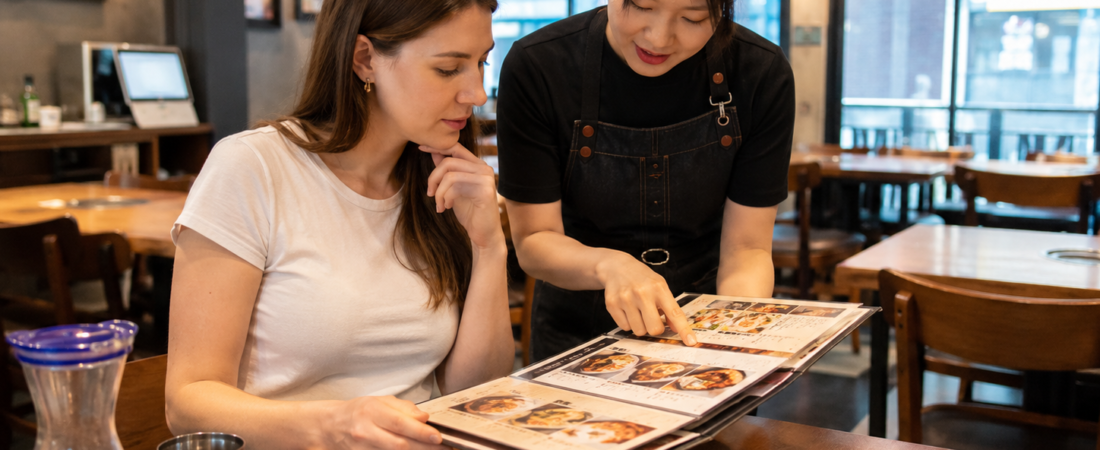
There is no single Korean restaurant ordering system.
Depending on the restaurant, you may order with staff at the table, at a counter, through a kiosk, or on a table-order screen. Some places also use other posted or digital instructions.
A practical approach is to read the ordering cue first, check the menu and any conditions, follow the service setup, and confirm how payment works before you leave.
Find out how this restaurant takes orders
Before sitting and waiting, look at what is happening around you.
Useful clues include:
- staff approaching tables
- a clearly marked counter
- a self-service kiosk near the entrance
- a tablet or order screen at the table
- a sign telling customers where to order
Digital ordering is common, but it is not universal.
If the setup is not obvious, watch what nearby diners do or ask staff. Do not force one “Korean restaurant rule” onto every venue.
For detailed kiosk operation, see How to Use Self-Service Kiosks in Korea.
Make sure you can use the menu before ordering
Some restaurants have English or multilingual menus. Others do not.
If there is no usable English menu, practical fallbacks include:
- pointing to the item
- using a menu photo or item number
- showing a written translation
- asking staff for clarification
For an ordinary choice, that may be enough.
If an ingredient or dietary restriction is important, do not rely only on the translated dish name. Broth, toppings, sauces, or other ingredients may not be obvious from the title.
In that situation, confirm the specific ingredient with staff where possible.
Check the exact item for minimum-order conditions
Some menu items are sold for one person. Others may be marked:
- for 2
- 2 servings
- set for two
- minimum order
- per-person order
These conditions are item- and restaurant-specific.
Do not assume that Korean restaurants generally require two servings, or that one shared-dish rule applies to the entire menu.
If the wording is unclear, ask whether the condition applies to that item or to the whole table.
For detailed solo-dining decisions, see Can You Eat Alone in Korea?.
Follow the service cues after you order
Some restaurants bring water, utensils, and side dishes to the table. Others use a self-service station.
You may also see a call button at the table. If one is provided, use it when you need staff.
Do not assume every restaurant has a call button or that every side dish, water station, or refill works the same way.
If you want to order more food, use the same ordering channel again if the system allows it. Otherwise, ask staff.
If you need to change or cancel something after submitting the order, ask staff as soon as possible. Whether a change is possible depends on the restaurant, system, and preparation status.
Confirm where and when payment happens
Payment can happen in different ways.
You may:
- pay when ordering at a kiosk or counter
- pay through a table-order system
- pay at a counter after eating
- follow another venue-specific process
Do not assume you will always receive a bill at the table, and do not assume every restaurant uses counter payment.
Before you leave, check whether you already paid or whether payment is still required.
If you are unsure, look at the counter or ordering system and ask staff rather than waiting indefinitely for a bill.
If something is unclear, stop and check
Most ordering problems are easier to solve before the order is complete.
If there is no obvious ordering method, pause and check the entrance, counter, table, and nearby diners.
If there is no English menu, point, use written translation, or ask staff.
If a minimum order is unclear, confirm the exact condition before ordering.
If self-service is unclear, follow the posted sign or ask rather than assuming staff will refill something automatically.
If the payment location is unclear, confirm it before leaving.