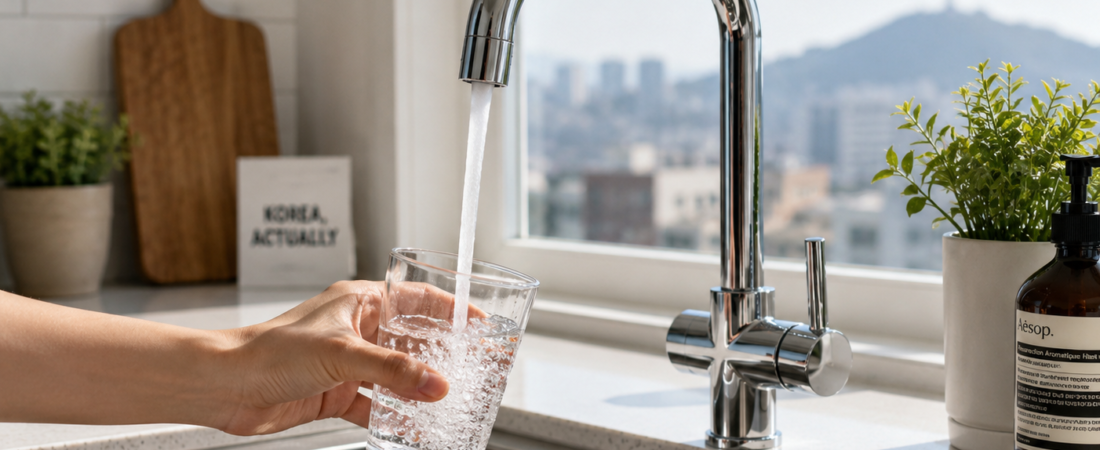
Yes. Tap water in Korea is generally safe to drink. Public water supplies are managed under national drinking-water quality standards.
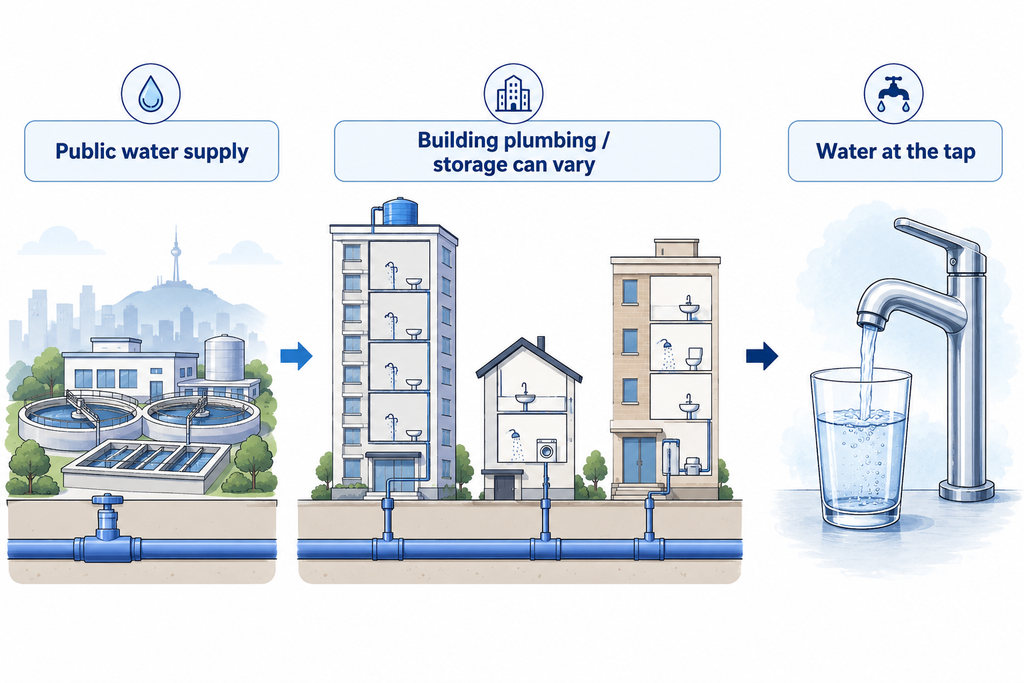
For travelers, there is one useful distinction to keep in mind: the quality of the public water supply and the condition of the plumbing or water tank inside a particular building are not the same question.
In normal conditions—no property warning, no known plumbing or tank problem, and no unusual color, cloudiness, smell, or taste—ordinary tap-water use is reasonable.
Public tap water and building plumbing are separate issues
Water can meet public drinking-water standards before it reaches a building and still be affected by what happens inside that building.
Internal pipes, shared building pipes, and water-storage tanks are separate parts of the system. Their condition and maintenance can affect the water that actually comes out of the tap.
That does not mean older buildings automatically have unsafe water. Building-level plumbing is simply one local factor to consider if something seems wrong or the property gives you a specific warning.
What does Seoul’s Arisu system show?
Seoul’s tap water, known as Arisu, is monitored from treatment through distribution and at taps.
Seoul also separately checks indoor pipes and water tanks and offers household tap-water quality verification. In its 2025 Arisu Quality Report, published in July 2026, Seoul reported that about 5,400 tests covering purification centers, taps, and public-use facilities met drinking-water standards.
That provides a useful Seoul-specific example of public drinking-water monitoring while also showing why building-level conditions can matter at the point of use.
Seoul’s system should not be treated as proof that every municipality in Korea uses exactly the same testing or household-service program.
When should you avoid drinking from the tap?
A simple appearance or smell check cannot prove that water is safe, but it can help you notice an abnormal condition.
If the water has:
- unusual discoloration
- abnormal cloudiness
- an unusual smell or taste
- a property-specific warning not to drink it
- a known plumbing or water-tank problem
check with the property, building manager, or local water provider.
Until the issue is clarified, use another drinking-water source.
Does using a purifier mean Korean tap water is unsafe?
No.
Using a purifier or filter does not by itself mean the tap water is unsafe.
People may use purifiers for many reasons, including taste, habit, preference, convenience, trust, or concern about the plumbing in a particular building.
The important distinction is between the regulated public water supply and an individual choice to filter water before drinking it.
Can you use Korean tap water for brushing your teeth and cooking?
In normal conditions, tap water that is suitable for drinking can also be used for brushing your teeth and cooking.
The same building-specific exception applies.
If the property tells you not to drink the water, or if there is an abnormal local condition, follow that guidance for ordinary potable-water use until the issue is resolved.
Do you need to buy bottled water?
Not automatically.
If the tap water is potable and there is no property-specific warning or known building issue, bottled water is a preference rather than a general requirement for visitors.
You may still choose bottled water because you prefer the taste or because a particular accommodation has given you a reason not to use the tap.
For a traveler, the practical check is:
- Start with the understanding that Korea’s public tap water is managed as drinking water.
- Check whether your accommodation has given you any warning.
- If the water looks, smells, or tastes unusual, ask the property or local provider.
- Use another drinking-water source until any abnormal building-specific issue is clarified.