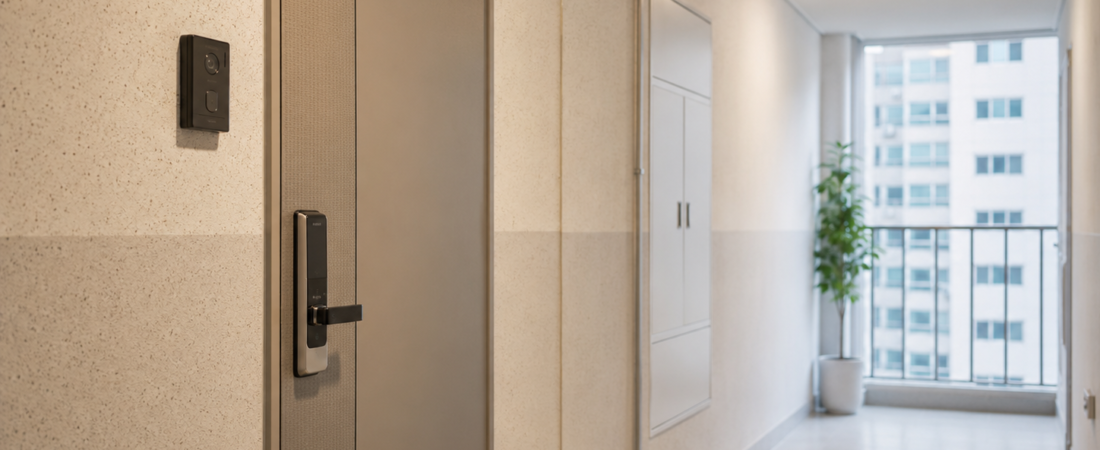
Digital door locks are widely familiar in Korea, especially in modern apartments and other multifamily housing.
But that does not mean almost every Korean home uses one, and there is no reliable nationwide household percentage in the current Research.
The strongest explanation is a combination of long market maturity, an apartment-heavy housing environment, and the everyday convenience of keyless entry.
Digital door locks have been established for decades
Digital door locks are not a recent smart-home novelty in Korea.
Korean research was already describing the domestic digital-door-lock market as moving toward maturity in the mid-2000s.
That matters because the technology has had a long time to become familiar in residential buildings rather than appearing only with the latest generation of connected homes.
Physical keys have not disappeared, however. Mechanical locks still exist, and some digital-lock models may also include a mechanical backup method.
Korea’s housing structure helps explain why they feel so normal
Korea has a strongly apartment- and multifamily-oriented housing environment.
According to the 2024 Population and Housing Census, apartments accounted for 65.3% of total housing, while multifamily housing accounted for 79.6%.
That does not prove apartments caused digital-lock adoption.
It does help explain why standardized residential entry systems can become highly visible in everyday life, especially in dense apartment and multifamily settings.
Korea’s housing structure is useful context for understanding normalization, but it should not be treated as the single cause.
The practical difference is keyless entry
For residents, the most obvious practical difference from a traditional lock is keyless entry.
Depending on the model, access may use:
- a PIN
- a card
- a fingerprint
- an app or connected method
- another product-specific method
No single method is standard across Korea.
A visitor should not assume that every digital lock uses a PIN, or that fingerprint, card, or app access will be available.
A building entrance and an apartment door may use different systems
In some multifamily buildings, the shared building entrance and the individual unit door are separate access layers.
That can be confusing for visitors because the method used at one entrance may not work at the other.
Do not assume that:
- every building has both systems
- one PIN or card works for both
- every accommodation uses digital access
Follow the property’s instructions for each entrance.
The important point is not how to operate a particular lock. It is recognizing that shared-building access and unit-door access may be different systems.
Digital does not automatically mean safer
It is easy to assume that a newer-looking lock must be more secure than a mechanical one.
That is not a reliable general rule.
Security depends on the specific product, installation, access method, credential management, and how the lock is used.
So digital locks should not be treated as categorically safer—or less safe—than physical-key systems.
Their everyday appeal is easier to explain through familiarity and keyless convenience than through a universal security claim.
What should a visitor do?
If you are staying in an apartment, rental, guesthouse, or other property, use the access instructions provided by the host or operator.
Do not assume that one property works like another.
A place may use:
- a shared entrance plus a separate unit lock
- one digital lock only
- a physical key
- staffed access
- another property-specific system
Follow the actual property instructions rather than trying to infer the access method from the building type.