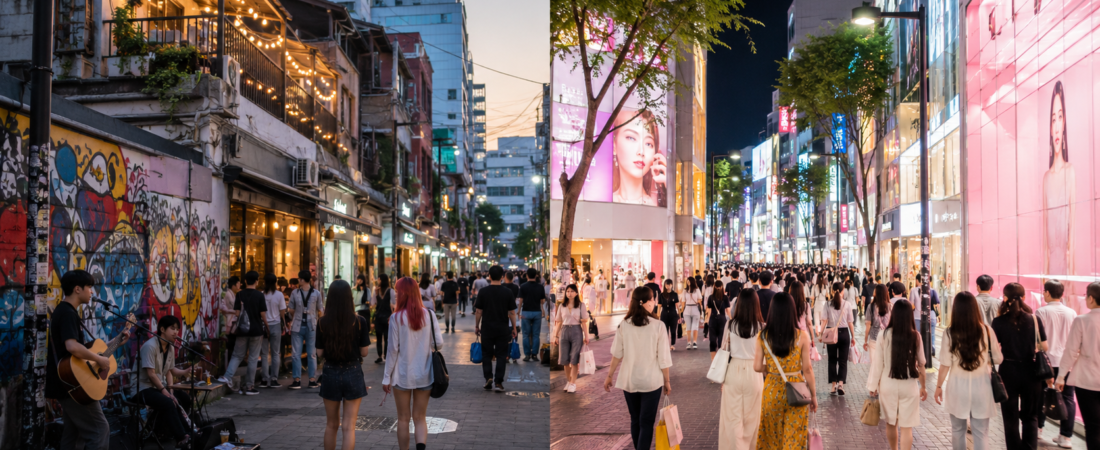
Hongdae and Myeongdong are both major visitor areas in Seoul, but they offer very different experiences.
Choose Hongdae if you want street culture, trend-focused shopping, performances, and an area that stays lively into the evening. Choose Myeongdong if you want concentrated shopping, cosmetics, department stores, and an area that fits easily into a day of central Seoul sightseeing.
There is no need to force a winner. The better choice depends on how you want to spend your time.
What does Hongdae feel like?
Hongdae is shaped by what happens in and around its streets.
Busking, dance performances, pop and indie culture, trend-oriented shops, cafés, restaurants, and themed streets all contribute to the atmosphere.
Browsing, street activity, music, and performance often blend together rather than feeling like separate attractions.
What does Myeongdong feel like?
Myeongdong is more strongly defined by its concentration of shopping.
Cosmetics, fashion, street-level shops, department stores, duty-free shopping, underground shopping, food, and visitor services are all part of the area.
It also has visible infrastructure for international visitors, including a multilingual tourist information center.
Shopping is a major draw in both areas
Both neighborhoods are strong for shopping, but the experience is different.
Myeongdong is better suited to concentrated mainstream shopping, especially cosmetics, department stores, street-level shops, duty-free retail, and other visitor-oriented shopping.
Hongdae is more closely associated with trend and street fashion, boutiques, flagship stores, character goods, and browsing that sits alongside the neighborhood’s street culture.
The question is not whether either area has shopping. Both do. The difference is the kind of shopping experience around you.
The evening feels different
Hongdae is more closely associated with busking, music, performances, clubs, and other late-day activity tied directly to the neighborhood.
Myeongdong remains active in the evening, but the experience is more centered on shopping and food than on nightlife or performance culture.
If you want the neighborhood itself to keep supplying street energy and entertainment later in the day, Hongdae is the stronger fit.
They fit differently into a sightseeing day
Myeongdong works naturally with central Seoul sightseeing.
Its location makes it easier to combine with nearby downtown areas and Namsan-related attractions as part of a broader day.
Hongdae works more naturally as a destination in its own right. Its streets, performances, shops, cafés, and nearby Yeonnam and Gyeongui Line walking areas can easily take up a larger part of the day.
Both are well connected
Hongik University Station is served by Line 2, the Gyeongui-Jungang Line, and AREX.
Myeongdong Station is on Line 4, and the wider Myeongdong area can also be reached from Euljiro 1-ga Station on Line 2.
Neither area is universally more convenient. The better location depends on where you are coming from and where you plan to go next.
Which one should you choose?
Choose Hongdae if street culture, performances, trend-focused browsing, and evening activity matter more to you.
Choose Myeongdong if your priorities are concentrated shopping, cosmetics, department stores, visitor-oriented services, and combining the area with central Seoul sightseeing.
If both experiences appeal to you, visiting both makes more sense than treating the choice as an either-or decision.
If your question is where to base yourself rather than which area to visit, see Where Should You Stay in Seoul?.