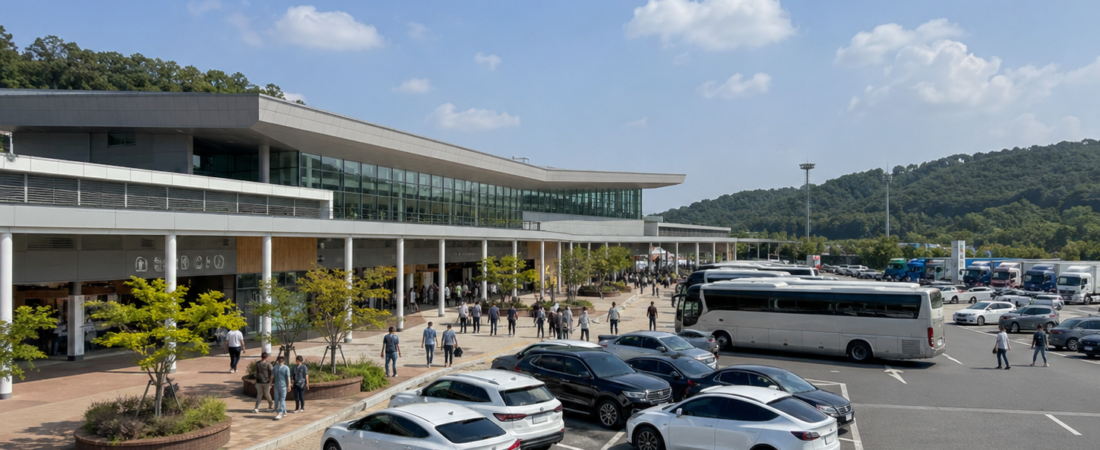
A Korean highway rest stop—more precisely, an expressway rest area or service area—is more than a simple roadside pull-off.
At the most basic level, you can expect a place to stop, rest, and use a public restroom. Larger rest areas may also have food, snacks, convenience retail, fuel, EV charging, and other traveler services.
The important point is that facilities vary by location, travel direction, and time of day.
A full rest area is different from a drowsy rest area
Korea Expressway Corporation treats full rest areas and drowsy rest areas as different facility categories.
A full expressway rest area is a service facility for travelers. Larger locations may include food, retail, fuel, EV charging, or additional amenities.
A drowsy rest area is a smaller safety-oriented stopping place intended for a short break when a driver is tired.
Do not assume that a drowsy rest area is simply a smaller version of a full service area with the same functions.
If you need food, retail, fuel, or another specific service, confirm that you are heading to a full rest area rather than a drowsy stop.
Restrooms and a place to rest are the basic expectation
The most reliable baseline is:
- a public restroom
- a place to stop and take a break
Beyond that, the exact setup depends on the location.
Korea Expressway Corporation’s rest-area system tracks optional amenities such as:
- sleeping rooms
- showers
- laundry facilities
- lounges
- barber shops
- nursing rooms
- pharmacies
- local agricultural-product shops
- dog parks
These are real rest-area services, but they are not available at every stop.
Check the specific rest area rather than assuming one national facility list applies everywhere.
Food is a real part of the experience, but menus vary
Food is one of the most noticeable features of many Korean expressway rest areas.
Larger locations may have restaurants, snack counters, or convenience retail, and some rest areas are known for representative or signature dishes.
Korea Expressway Corporation organizes representative-food information by route, rest area, and travel direction.
That does not mean every rest area has a famous dish or the same food-court setup.
Menus, shops, prices, and opening hours can change, so exact food information should be treated as location-specific and current rather than evergreen.
Fuel and EV charging should be checked stop by stop
Many travelers expect a service area to include fuel, but not every rest area should be assumed to have a gas station.
Korea Expressway Corporation manages gas-station information separately, which is another reason to verify the stop you plan to use.
The same applies to EV charging.
EV chargers are present at expressway rest areas, and the network is still being expanded, but charger availability, type, count, and operating status can change.
If fuel or charging is essential, check that specific rest area before relying on it.
The same rest-area name can mean different facilities by direction
Travel direction matters more than many first-time visitors expect.
Korea Expressway Corporation treats direction as a separate data field in its rest-area systems.
That means two facilities with the same or similar name on opposite sides of the expressway may not have identical:
- food options
- retail
- parking
- fuel
- traveler services
When looking up a stop, check both the rest-area name and your travel direction.
The rest area may be open when individual services are not
Do not assume that every restaurant, shop, pharmacy, or service counter inside a rest area follows the same schedule.
The rest area itself may still be accessible while individual businesses or services have their own operating hours.
This matters most late at night or early in the morning.
If you need a specific service, check the current hours for that service rather than assuming the entire complex operates 24 hours.
What should a first-time visitor do?
A simple first-stop sequence works well:
- Confirm that you are entering a full rest area rather than a drowsy rest area if you need food, retail, fuel, or other services.
- Use the restroom and take a break first.
- Check the current food and shop options if you want to eat or buy something.
- If you need fuel or EV charging, verify that specific stop before relying on it.
- Check both the rest-area name and travel direction when looking up facilities.
- Late at night or early in the morning, confirm the hours of the specific shop or service you need.