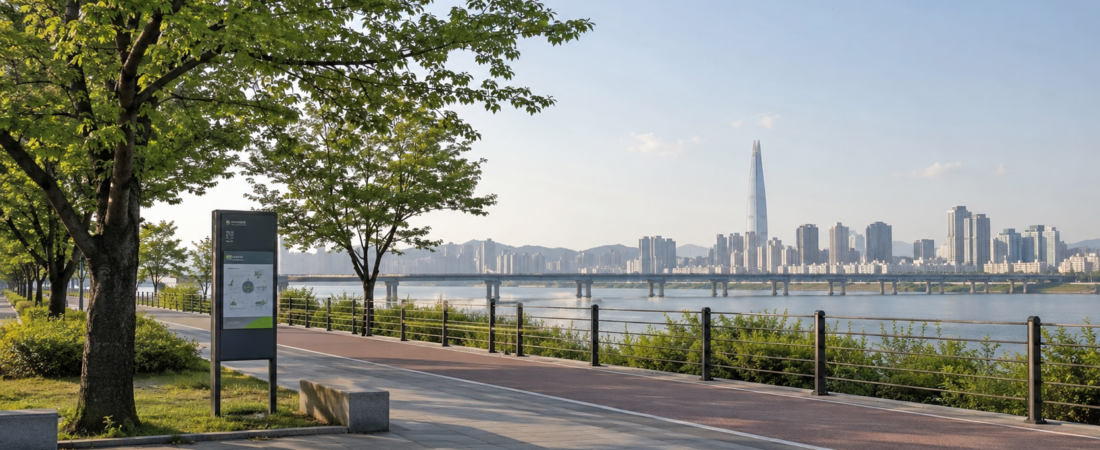
There is no single nationwide rule that makes every public place in Korea either an alcohol-permitted or alcohol-prohibited zone.
Under Korea’s current national framework, local governments can designate specific public places as no-alcohol zones. Once a place is formally designated, alcohol consumption is prohibited there and the area must be marked with official signage.
So the practical question is not simply, “Is public drinking legal in Korea?” It is: Is this specific place covered by a local no-alcohol designation, facility rule, or event rule?
Look for a no-alcohol sign
The strongest on-site clue is an official no-alcohol sign.
You may see wording such as:
- 금주구역 — no-alcohol zone
- 음주금지 — alcohol prohibited
Official signs can also state the restricted area, applicable hours, and possible penalty.
If a place is formally marked as a no-alcohol zone, the restriction applies to that area.
Do not assume that a no-smoking sign means the same thing. No-smoking and no-alcohol rules come from different legal systems and should be checked separately.
Local governments can set different restrictions
National law creates the framework, but local governments decide which places to designate through local ordinances.
Depending on the jurisdiction, designated areas can include places such as:
- urban parks
- children’s play areas
- school-related zones
- bus stops or taxi stands
- medical facilities
- other public places selected by the local authority
These are examples of places that can be designated, not a single nationwide list.
A rule that applies in one district or city should not be treated as the rule for every park or public space in Korea.
Parks, events, and facilities may have their own rules
A public park may be affected by a local no-alcohol designation, but that is not the only possible restriction.
Events, festivals, pools, transport facilities, and other managed spaces can also apply their own operating rules.
For example, a specific event area inside a larger park can prohibit alcohol without creating a permanent rule for the entire park.
The same distinction matters for transport facilities and commercial spaces. A managed seating area, station, terminal, or event venue is not automatically governed by the same rules as the surrounding public space.
What about the Han River?
There is no useful evergreen rule such as “drinking is always allowed at the Han River” or “alcohol is banned throughout all Han River parks.”
Current official materials show that particular Han River events, pools, or activity zones can prohibit alcohol, while the broader park framework does not support one simple permanent rule for every location.
Because these restrictions can change by event, zone, or season, any specific Han River claim needs a current official check for that place and date.
The same caution applies to beaches, festivals, and temporary event sites.
Fines are not one fixed nationwide amount
National law allows a fine of up to KRW 100,000 for violations in designated no-alcohol zones.
The actual amount is set by the relevant local ordinance, so it can differ by jurisdiction.
That means one city’s fine should not be quoted as the standard amount for all of Korea.
Keep separate rules separate
Alcohol restrictions are only one part of public-space regulation.
Separate rules may also apply to:
- smoking
- littering
- noise
- obstruction
- event conduct
- facility use
The fact that a place is not marked as a no-alcohol zone does not automatically answer every other legal or behavioral question about that space.