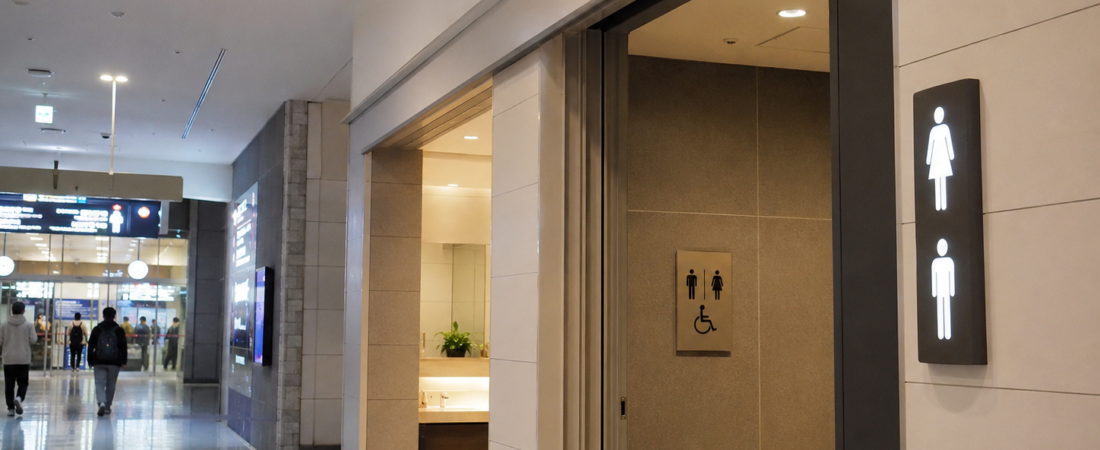
Public restrooms in Korea are easy to find in many busy areas, but access, opening hours, paper supply, and facilities can vary.
For a first visit, a practical approach is:
- look first in a high-probability place
- check whether the restroom is actually accessible from where you are
- check for toilet paper before use
- follow any disposal sign in that specific restroom
- ignore unfamiliar optional controls if you do not need them
- use another nearby facility quickly if the first option is locked, closed, or unavailable
A good place to start is a station, terminal, park, mall, department store, or public building rather than assuming every café or convenience store has a restroom.
Look first in high-probability places
Useful first places to check include:
- subway or train stations
- bus terminals
- airports
- parks
- malls and department stores
- public buildings
These categories commonly include public-restroom facilities, but opening hours still vary by location.
Official restroom data can help you find a location, but a map or database result is not proof that the door is open right now.
Use search results as a lead, then verify the signs, entrance, and opening hours on site.
Check whether you can actually access it
Finding a restroom on a map does not always mean you can walk straight in.
At subway stations, the restroom may be inside or outside the fare gates depending on the station.
Check the station signs before crossing a gate just to reach a restroom. If it is unclear, ask station staff.
At cafés, restaurants, or commercial buildings, the restroom may be:
- inside the business
- elsewhere in the building
- customer-only
- locked
- code-protected
- key-operated
- unavailable
Check the receipt, door notice, or ask staff instead of assuming every commercial restroom works the same way.
Check for toilet paper before use
Do not assume every stall always has toilet paper.
Check the stall before you use it. In some facilities, paper may also be placed in a shared dispenser outside the stall.
Carrying a small tissue backup can be useful if the dispenser is empty.
For ordinary toilet paper, the modern public-restroom default in Korea is to flush it in the toilet.
The old blanket advice to never flush toilet paper in Korea is outdated for modern public restrooms.
If a specific restroom has a posted disposal sign telling you to do something different, follow that sign for that facility. For the detailed disposal rule, see Can You Flush Toilet Paper in Korea?
Do not assume every restroom has the same equipment
Public restrooms can vary in toilet type and available facilities.
You may encounter:
- Western-style toilets
- an occasional squat toilet
- electronic bidets
- accessible stalls
- children’s or family facilities
None of these is guaranteed everywhere.
Bidets are optional. If the controls are unfamiliar, you do not need to use them.
If accessible or family facilities matter to you, check the specific station, building, or official facility information rather than assuming they will be available.
What if the restroom is locked, closed, or unavailable?
Move quickly to another high-probability facility instead of spending too long trying to make one location work.
If the door asks for a code:
- check the receipt or door notice
- ask staff rather than repeatedly guessing codes
If the restroom is locked:
- check the posted opening hours
- ask building or station staff
- try another station, terminal, mall, department store, or public building
If there is no toilet paper:
- check for a shared dispenser
- ask staff if available
- use your tissue backup
If a map result is wrong or the restroom is closed:
- use the next nearby high-probability facility
Late at night, do not rely on one nationwide rule about what will be open. A large active station, terminal, or currently operating public building can be a useful fallback, but verify that it is actually open.