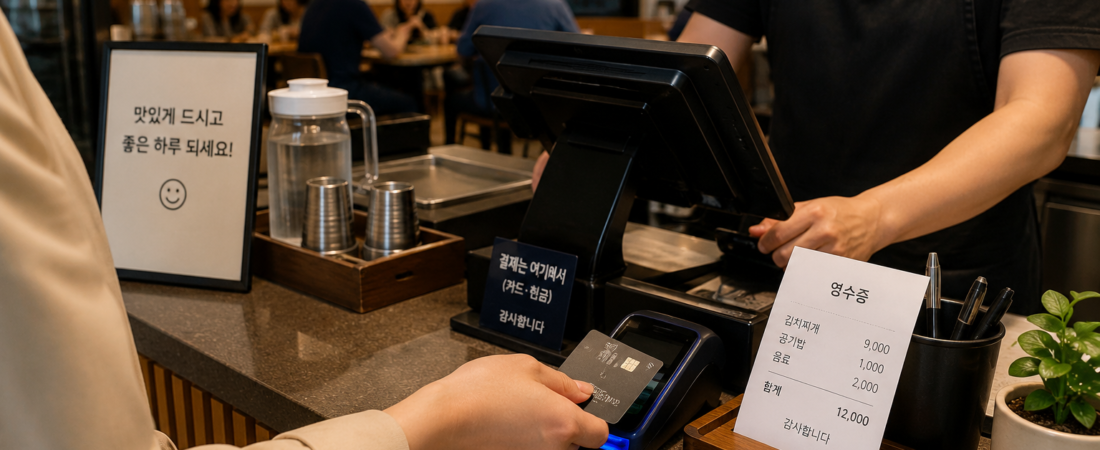
Tipping is generally not expected in Korea.
For ordinary restaurants, cafés, and taxis, the normal baseline is to pay the stated amount without adding a percentage tip.
That does not mean tipping is forbidden. Some specific services may offer an optional tip, and some hotels or upscale venues may include a separate service charge. Those are different from a general cultural expectation to tip.
Restaurants and cafés: usually just pay the stated amount
At ordinary Korean restaurants, tipping is not generally required or expected.
You do not need to calculate an extra percentage at the end of the meal. The practical approach is to pay the amount the restaurant says you owe.
The same broad baseline works for ordinary cafés.
That does not mean every café or payment system works identically, but there is no general expectation that visitors should add a tip simply because they received normal service.
Taxis: usually, no tip is needed
For most ordinary taxi rides, tipping is not required.
Pay the fare shown by the meter or service.
Some taxi-related services may offer a voluntary extra-tip feature. If you see one, treat it as an option provided by that specific service—not as evidence that tipping is expected across Korea.
You do not need to add anything beyond the required fare unless you choose to use a clearly optional service-specific tip feature.
A service charge is not the same as a tip
This distinction matters.
A service charge is a fee set by the business and disclosed as part of the price or booking terms.
A tip is a voluntary extra payment from the customer.
Some hotels, restaurants, or higher-end services may include a service charge. If the charge is already part of the amount you are required to pay, that does not mean you are also expected to add another percentage tip.
Check the bill, booking page, or property terms if you are unsure.
What if a hotel or higher-end service has its own policy?
Tipping is not a general Korean hospitality rule, but individual businesses can set their own service-charge or gratuity terms.
If a hotel, package, or specialized service clearly states its own charge, follow the current terms for that business.
Do not assume that every high-end hotel or restaurant adds the same percentage.
Follow the actual property or service terms rather than a generic tipping formula.
What if an app or payment screen offers a tip?
An optional tip prompt can exist in a specific service.
If you see one, read it as exactly that: optional for that service.
It does not create a nationwide expectation that you should tip taxis, restaurants, cafés, or other businesses.
If no tip option or service-specific instruction appears, the ordinary baseline is still to pay the stated amount.
What if the service was especially good?
Good service does not create an automatic tipping obligation in Korea.
You can simply thank the staff and pay the required amount.
If a specific service clearly provides an optional gratuity feature and you choose to use it, that is your choice.
The important distinction is that optional appreciation is different from an expected tip.