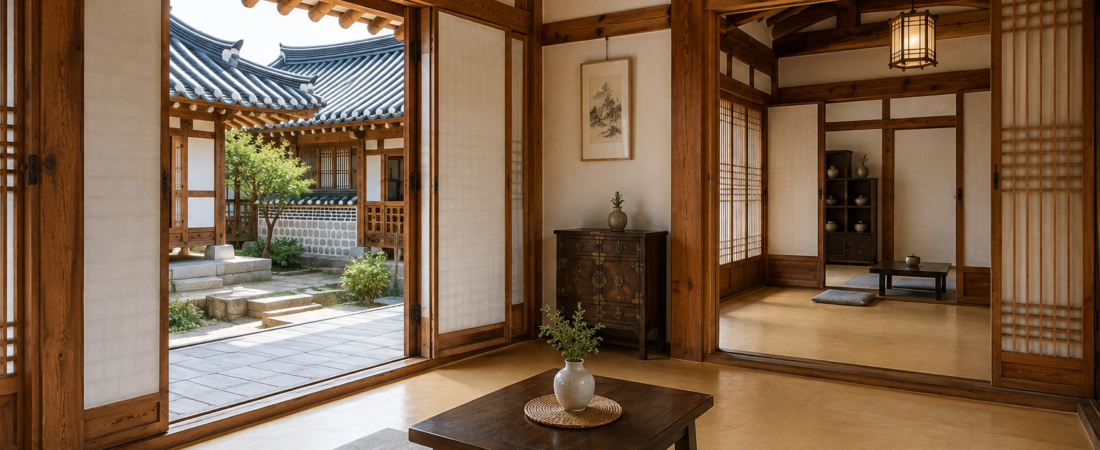
A hanok is a Korean house or building based on traditional Korean architectural form.
A useful architectural anchor is a wooden structural framework using posts and beams together with a Korean-style roof frame. Beyond that, hanok can vary widely by region, historical period, social context, original purpose, and how the building is used today.
A hanok is therefore better understood as a traditional architectural form than as one fixed house layout.
What features are common in hanok?
Many hanok share recognizable architectural features such as:
- a wooden structural framework
- a traditional roof form
- ondol, or underfloor heating
- maru, a raised wooden-floor space
- a yard or courtyard
- natural materials such as wood, earth, stone, or hanji
These are representative features, not a checklist that every hanok must have.
For example, not every hanok has a courtyard, tiled roof, maru, or ondol in every room.
Hanok can look different across Korea
Traditional hanok developed differently depending on climate, region, social status, function, and period.
Historical examples show that climate influenced layout choices. Colder areas could favor more enclosed arrangements, while warmer areas could make greater use of open or wood-floored spaces that supported ventilation.
But this should not be read as a strict north-versus-south floor-plan rule. Hanok layouts also varied within regions and according to period, social context, and the building’s purpose.
For a visitor, the important point is that there is no single nationwide hanok floor plan.
Historic hanok and modern hanok are not the same thing
Some hanok are older surviving or restored traditional buildings.
Others are reconstructed or newly built.
A modern hanok, sometimes called a sinhanok, can keep major traditional forms while using contemporary materials, building systems, bathrooms, kitchens, insulation, or other modern features.
A building can also be hanok-style without being a centuries-old traditional house.
A newer hanok is not automatically inauthentic.
What are hanok used for today?
Hanok are used in many different ways.
They can be:
- private homes
- cultural or public spaces
- cafés or restaurants
- galleries, shops, or studios
- guesthouses or other accommodations
A hanok is not automatically a tourist attraction. Some are places where people still live or work.
What is a hanok village?
A hanok village is an area with a concentration of hanok, but it is not one standardized type of attraction.
Depending on the place, a hanok village may be:
- a living residential neighborhood
- a historic village
- a restored cultural complex
- a tourism or commercial area
- an accommodation-focused area
Not every hanok village functions like an outdoor museum.
Check what the specific place is before you visit.
What should you expect from a hanok stay?
A hanok stay is not a standardized hotel experience.
Many hanok accommodations use floor mats and blankets, while others provide beds.
Modern amenities also vary. Some properties may have private bathrooms, Wi-Fi, air conditioning, kitchens, or other contemporary facilities.
If you prefer a bed or need a particular amenity, check the individual property before booking.
You may also be asked to follow property-specific indoor customs, such as removing your shoes, so follow the instructions provided by the accommodation.
Is ondol part of a hanok?
Ondol, Korea’s traditional underfloor-heating system, is strongly associated with hanok and Korean domestic architecture.
But it should not be treated as a feature of every room in every hanok.
It is one important architectural idea within a much more varied building tradition.