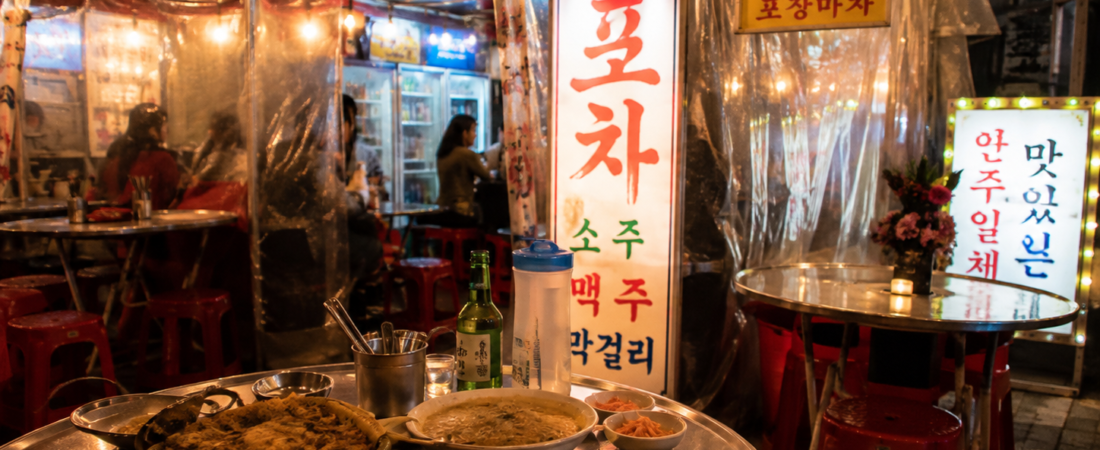
A pocha is a Korean food-and-drink venue that can take several forms.
The traditional image is a tented or temporary pojangmacha stall, but modern pocha can also be fixed indoor restaurants or contemporary venues inspired by that style.
For a first visit, the practical approach is to see how that particular venue works:
- identify the venue type
- check the seating and ordering flow
- read the food and service setup
- check whether a food-only or non-drinking visit fits the venue
- confirm payment, restroom access, and hours if they matter to you
- choose another venue if the setup is not a good fit
First, identify what kind of pocha it is
A pocha may be a traditional tented or temporary stall, a fixed indoor restaurant, or a modern pocha-style venue.
A small tented stall may have simple stools or limited seating, while an indoor pocha may work more like a regular restaurant.
Pocha should not be treated as either exclusively street tents or exclusively indoor pubs.
Check the seating and ordering setup
There is no single pocha seating or ordering system.
Depending on the venue, you may find staff-directed seating, simple stools or tables, standard restaurant seating, table ordering, a call bell, tablet or QR ordering, or direct ordering with the vendor or counter.
If the seating is unclear, wait for staff direction rather than assuming any empty seat is available.
Then check how the venue takes orders before settling in.
Treat food as part of the main experience
Food is a core part of the pocha concept.
Menus can include cooked dishes, snacks, seafood, soups, or other shareable items, but the exact menu depends on the venue.
Check the menu, portion, and any minimum-order note before ordering.
There is no Korea-wide rule requiring one dish per person, one appetizer minimum, or a specific alcohol order at every pocha.
If the quantity or requirement is unclear, ask staff before the order is prepared.
Can you visit a pocha without drinking alcohol?
A pocha should not automatically be treated as a place where alcohol is required for entry.
Many modern pocha operate as restaurant-style food venues, but the exact expectations and menu structure are venue-specific.
If you do not drink, check whether the menu has food you want, whether non-alcoholic drinks are available, whether there is any minimum-order policy, and whether the atmosphere feels comfortable for your visit.
Some venues may suit a non-drinking visit better than others, so check the setup rather than assuming either extreme.
Check payment, restroom access, and hours
Payment methods vary.
Some fixed indoor pocha accept cards, while smaller or temporary venues may use a different payment setup.
Pocha should not be treated as uniformly cash-only, and foreign-issued card acceptance can still vary by venue.
Restroom access also varies. Some indoor venues have their own restroom, while outdoor or temporary setups may rely on a nearby building, shared facility, or public restroom.
Hours vary just as much. Not every pocha stays open until dawn.
If you plan to stay late, check the actual venue’s current closing time.
What about smoking and atmosphere?
Indoor restaurant-style pocha are no-smoking areas.
Outdoor or tented environments can feel different, and nearby smoke exposure may still be possible depending on the setting.
Atmosphere also varies. Some pocha are lively and noisy, while others are calmer.
If the venue is too loud, crowded, smoky outdoors, or otherwise uncomfortable, asking for another seat or choosing another venue is a practical option.
What if something goes wrong?
Most small problems are easier to solve by checking with staff rather than guessing the venue’s system.
If there are no seats or the wait is too long, ask whether there is a wait list or choose another nearby venue.
If the order is wrong, confirm the item and quantity with staff immediately.
If payment is a problem, try another payment method accepted by that venue.
If there is no restroom, ask whether there is a nearby shared, building, or public facility.
Pocha is a broad venue category, so the most useful first-visit habit is to read the seating, ordering, food, payment, and facility setup in front of you.