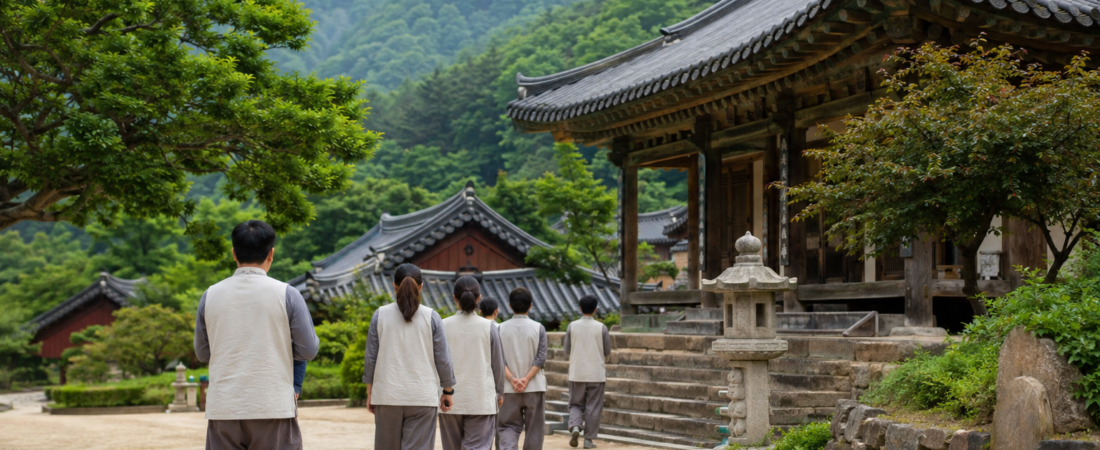
A Temple Stay in Korea is a structured cultural experience program at a Buddhist temple. It is not simply a place to sleep, and it is different from visiting a temple on your own.
Programs are designed to help participants experience aspects of Korean Buddhist culture and temple life. What you actually do depends on the temple, season, program type, and current schedule.
A Temple Stay is a program, not just accommodation
The main point of a Temple Stay is participation.
A program may include time at the temple, guided activities, quiet rest, cultural experiences, or other scheduled elements. Accommodation can be part of some programs, but it is not the defining feature.
It is better to think of Temple Stay as a cultural participation program rather than a temple hotel.
You do not always stay overnight
The official Templestay system currently uses three broad program types:
- One-day Templestay
- Experience-oriented Templestay
- Rest-oriented Templestay
The existence of the One-day type means an overnight stay is not universal.
Experience-oriented programs may include more scheduled cultural or Buddhist activities. Rest-oriented programs generally place more emphasis on quiet time and staying at the temple with a lighter activity schedule.
The exact structure still varies by temple and program.
A Temple Stay is different from an ordinary temple visit
You can visit many Korean temples without joining a Temple Stay.
An ordinary visit may involve looking around the grounds, seeing temple buildings, or spending a short time at the site.
A Temple Stay is different because you join an organized program with its own schedule, participation rules, meeting time, and instructions.
If you only want to see a temple, you do not necessarily need a Temple Stay.
If you want a more structured experience of temple life and culture, a Temple Stay may be a better fit.
Foreign and non-Buddhist visitors can participate
Foreign visitors can join Temple Stay programs, and some current official programs specifically serve international participants.
You also do not generally need to be Buddhist to consider a Temple Stay.
But that does not mean every program has identical eligibility.
Age limits, guardian requirements, group rules, capacity, language support, or other participation conditions can differ by program.
Check the current program page before booking.
Activities vary from one program to another
Possible activities can include:
- a temple tour
- Seon meditation
- tea
- a monastic meal
- a Buddhist service
- traditional cultural activities
- other temple-specific experiences
Some programs may also include chanting, 108 prostrations, crafts, communal work, or other activities.
These are examples, not a nationwide checklist.
Do not assume that every Temple Stay includes meditation, chanting, prostrations, or the same meal experience.
Rooms, language support, and conduct rules also vary
Room arrangements are not identical.
Shared rooms are common in the official orientation, but some programs may offer private rooms or use different group or gender arrangements.
English-language or translated support exists at some programs, but it is not guaranteed everywhere.
Program rules can also differ. Broadly, visitors should expect to be considerate, arrive on time, follow staff or temple instructions, and dress appropriately for the setting.
If a particular activity, room type, language, or conduct rule matters to you, confirm it on the current program page rather than assuming one national standard.
What should you check before booking?
Use the current program page to check:
- Program type: Is it One-day, Experience-oriented, or Rest-oriented?
- Language: Is the language support you need actually listed?
- Participation: Are there age, guardian, group, or other eligibility conditions?
- Activities: Which activities are included, and are any marked optional or required?
- Room: Is the arrangement shared, private, gender-separated, or otherwise specified?
- Timing: Do the arrival time, schedule, and stay length fit your trip?
- Booking terms: What are the current price, reservation deadline, and cancellation or refund rules?
Those details can change by temple and program, so the current listing matters more than a generic Temple Stay template.