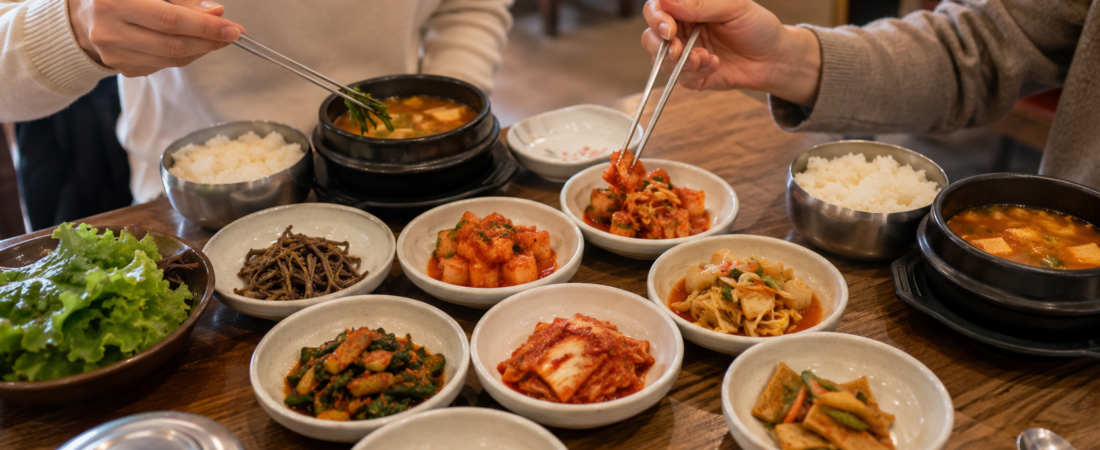
Korean meals often combine individual staples with dishes placed for the table to share.
A common setup is that each diner has their own rice and soup, while several banchan—side dishes—are arranged where everyone can reach them.
That table structure explains a lot. Sharing banchan is not simply a matter of “Koreans like sharing.” It is a practical way to eat a meal built around several small dishes at once.
Banchan are part of the meal, not just free extras
Banchan means the side dishes served alongside rice and other parts of a Korean meal.
Depending on the meal, these can include things such as kimchi, seasoned vegetables, stir-fried dishes, or braised foods.
It is better to think of them as part of the meal structure than as “free food.”
In many restaurants, basic banchan are included with the meal rather than ordered separately. But specialty sides, add-ons, or separate menu items may cost extra.
The table often mixes individual and shared dishes
One common Korean table setup is:
- rice in front of each diner
- soup in front of each diner
- several banchan arranged across the table
- other dishes placed according to the menu and restaurant style
That makes shared side dishes practical: everyone can take different bites of banchan while eating their own rice.
But this is a common pattern, not a fixed formula.
Some soups, stews, or main dishes may be shared. Others may be individual. The exact setup depends on the restaurant, household, menu, and group.
Sharing works because several dishes are available at once
A Korean meal may offer several different flavors and textures at the same time.
Instead of choosing only one side dish, diners can combine different banchan with their own rice throughout the meal.
That helps explain why sharing is so common: multiple dishes are already arranged for the table, so shared access fits the way the meal is served.
There is also a cultural history of shared eating in Korea, but it would be too simple to say one value such as collectivism created the modern restaurant table.
Korean dining has also included individual-serving traditions, so “Korean meals are always communal” is not accurate.
Follow the table setup rather than inventing one etiquette rule
If a dish is clearly placed in the middle for everyone, it is usually reasonable to treat it as shared unless the restaurant or host indicates otherwise.
If serving utensils or small plates are provided, use them.
If they are not, follow the restaurant or host setup rather than assuming there is one nationwide rule about whether personal chopsticks may touch a shared dish.
You also do not need to eat every banchan that appears on the table.
Try what you want and leave what you do not want.
Are banchan refills always free?
No.
Some restaurants refill certain side dishes without an extra charge. Some use a self-service refill station. Others have different limits or charge separately for particular items.
So do not assume that every banchan comes with unlimited refills.
If you want more, check for a self-service sign or ask staff.
The same applies to what is included with the meal: basic banchan are often included, but the exact policy belongs to that restaurant and menu.