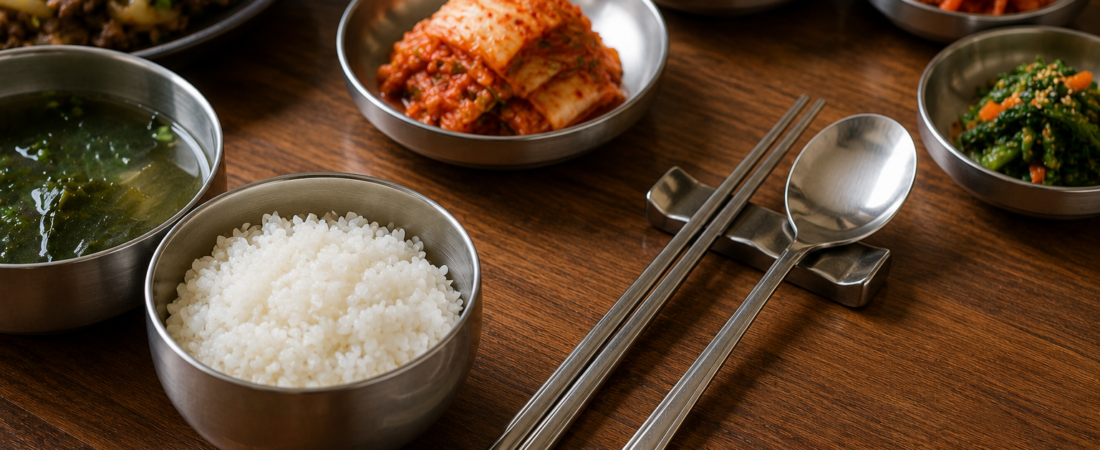
Metal chopsticks are common in Korea today, especially stainless-steel ones, but there is no single proven origin story that explains the whole tradition.
Korea has a long documented history of metal eating utensils, including bronze and silver chopsticks and spoon-and-chopstick sets. Modern stainless-steel chopsticks, however, belong partly to a much later chapter of Korea’s industrial and material history.
The clearest way to understand the tradition is this: metal utensils have deep roots in Korea, while today’s stainless-steel chopsticks became practical, durable everyday tableware in the modern era.
Metal chopsticks have a long history in Korea
Metal chopsticks are not a recent invention.
Museum collections preserve bronze chopsticks and spoon-and-chopstick sets from the Goryeo period, as well as later metal examples from the Joseon period. Silver spoon-and-chopstick sets also survive.
That shows that metal eating utensils have been used in Korea for centuries.
What the evidence does not show is one simple reason why Koreans began using them.
Popular explanations often try to reduce the tradition to a single origin story, but the historical record is more complicated.
Today’s stainless-steel chopsticks are a modern chapter
The metal chopsticks most visitors encounter today are usually stainless steel.
It is tempting to treat them as an unchanged continuation of medieval bronze or silver chopsticks, but that is too simple.
Modern stainless-steel flatware spread in Korea through the country’s 20th-century industrial development, especially during the postwar decades.
That means today’s familiar stainless-steel table setting should be understood as a modern form built on a much older history of metal utensils—not as an ancient design copied unchanged into the present.
What about the poison-detection story?
You may hear that Korean royalty used silver chopsticks because silver could detect poison.
There is a small piece of real chemistry behind that story: silver can tarnish when it reacts with sulfur compounds.
But that does not prove that poison detection was the main reason Korea developed a metal-chopstick tradition.
The historical and museum evidence supports long use of metal utensils, but it does not establish poison detection as the central origin.
It is better treated as a popular story than as settled history.
Why does stainless steel make sense today?
Stainless steel has several practical advantages for everyday tableware.
It is:
- durable
- reusable
- easy to wash repeatedly
Those are good modern reasons for stainless steel to work well in restaurants and homes.
But they should not be confused with historical origins. Saying stainless steel is easy to clean is very different from saying Koreans originally adopted metal chopsticks because of hygiene.
The first claim is practical. The second is not established by the evidence.
Why do Korean metal chopsticks feel different?
Many modern Korean stainless-steel chopsticks are relatively thin, smooth, and sometimes flat or flattened.
That can make them feel unfamiliar if you are used to disposable wooden or bamboo chopsticks.
But not every Korean chopstick has the same shape, and historical examples were not all flat. Museum pieces include round-section chopsticks as well.
For a first-time user, the main difference is often control rather than technique.
Try:
- holding them around the middle-to-upper area
- using a lighter grip instead of squeezing hard
- focusing on control rather than perfect form
If they still feel awkward, that is completely manageable at a Korean table.
Use the spoon when it is easier
Korean dining traditionally uses the spoon and chopsticks together.
That pairing also has a long history, with spoon-and-chopstick sets documented in older Korean material culture.
Today, the spoon is commonly used for rice and soup.
So if metal chopsticks feel difficult, you do not need to force yourself to use them for everything. Use the spoon when it gives you better control, especially for rice or soup.
One simple etiquette point is worth remembering: avoid leaving chopsticks standing upright in a bowl of rice. That arrangement is associated with ancestral rites and is generally avoided in ordinary meals.
Beyond that, there is no need to turn your first meal into a chopstick test.