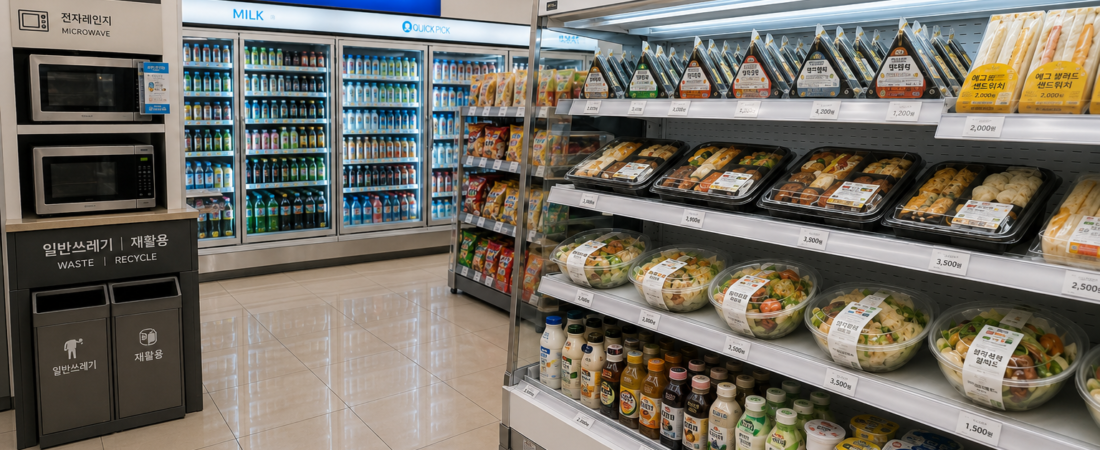
Korea’s convenience stores feel unusually visible because a very large, mature store network fits several everyday needs at once.
Official 2024 franchise data counted about 54,800 convenience-store franchise locations, making convenience stores the largest franchise-industry category by establishment share. But the network was essentially flat from the previous year, so this is better understood as a large, established system than an endless growth boom.
What keeps the format useful is the combination of nearby small purchases, small-household demand, ready-to-eat food, flexible hours, and branch-level services. No single factor explains the whole system.
The network is already very large
Convenience stores are not just a recent urban trend in Korea.
Official 2024 franchise statistics recorded 54,780 convenience-store franchise establishments, accounting for 17.5% of all franchise establishments.
That scale helps explain why the stores can feel like part of the basic neighborhood landscape, especially in dense commercial and residential areas.
But the important point is maturity, not explosive expansion. The 2024 store count was down slightly year over year, so it is more accurate to think of Korea as having a large established network than a rapidly accelerating boom.
They fit quick, nearby purchases
A convenience store works well when the goal is not a large weekly shopping trip but a small purchase close to home, work, or transit.
Recent retail data link convenience-store demand to local shopping convenience and small purchases.
That fits the format naturally: a small nearby store can handle one drink, a snack, a basic household item, or a quick meal without requiring a larger shopping trip.
Dense neighborhoods can make that model especially useful, although urban density alone should not be treated as the single cause of Korea’s store network.
Small households make small-quantity shopping more useful
One-person households make up a large share of Korean households.
In 2024, Korea had about 8.04 million one-person households, or 36.1% of general households. In Seoul, the share was higher.
That does not mean one-person households created Korea’s convenience-store industry.
It does mean the format fits a society where many people may prefer small quantities, individual portions, and quick purchases rather than bulk buying every time.
This is one reason the same small-store format can remain useful even as online shopping grows.
Ready-to-eat food makes the store more than a snack stop
Convenience stores in Korea are also used for quick meals, not only drinks and packaged snacks.
Common examples include:
- lunchboxes
- samgak gimbap
- cup noodles
- other ready-to-eat or instant foods
That gives the store a broader role in everyday life, especially when someone wants a fast individual meal or something outside normal mealtime routines.
But it would be an exaggeration to say convenience-store food is the center of Korean food culture or that most meals are eaten this way.
Its importance comes from convenience, not dominance.
Many stores stay open late, but not every store is 24 hours
Long opening hours make convenience stores useful at times when some other shops are closed.
Many branches stay open very late or around the clock.
But 24-hour operation is not universal. At least one major chain allows franchisees to choose between shorter daily operation and 24-hour service, and its store finder treats 24-hour status as a branch-level feature.
So if opening hours matter, check the specific branch instead of assuming every Korean convenience store is open all night.
Some branches work like small neighborhood service points
Convenience stores can also offer services beyond retail.
Depending on the chain, branch, and equipment, a store may offer things such as:
- parcel or pickup services
- an ATM
- bill payment
- transit-card top-up
- other small everyday services
These extras help explain why a convenience store can feel more like neighborhood infrastructure than a simple snack shop.
But they are not guaranteed at every branch.