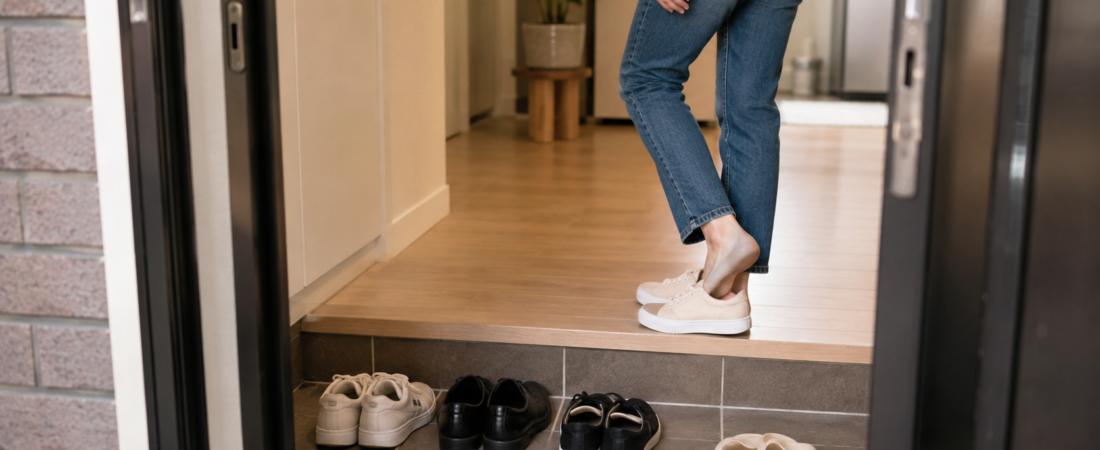
In a Korean home, a good default is simple: pause at the entrance and expect to remove your outdoor shoes.
But that does not mean shoes come off in every indoor space in Korea. Most ordinary shops, cafés, museums, hotels, and chair-seating restaurants use normal footwear.
The useful skill is to read the boundary between outdoor and indoor space.
Look for a step, shoe area, shoe cabinet or rack, raised floor, provided slippers, a floor-seating zone, or what the host or staff is doing.
Why is taking shoes off so strongly associated with Korean homes?
The custom is closely connected to Korea’s long tradition of ondol, or underfloor heating, and to floor-level living.
Traditional heated rooms were not just places to walk through. The floor could be used for sitting, eating, resting, and sleeping.
That made the indoor floor part of the living space itself.
Ondol is an important part of the explanation, but it is not the only cause. Housing layout, the boundary between outdoor and indoor space, floor cleanliness, furniture habits, and long-term custom all developed together.
So “Koreans take off their shoes because of ondol” is useful only as a partial explanation.
Read the entry boundary
When you are unsure, do not start by asking whether the building is “traditional.”
Look at the entrance.
Useful signs include:
- outdoor shoes clustered near the door
- a shoe cabinet or rack
- a lowered entry area
- a raised interior floor
- a separate floor-seating section
- indoor slippers waiting at the boundary
- the host, staff, or other guests removing their shoes
These cues are usually more useful than the venue label itself.
At someone’s home, pause at the entrance and follow the host’s setup.
You do not remove your shoes in every restaurant or café
An ordinary chair-seating restaurant or café does not normally become a shoes-off space just because it is in Korea.
But some traditional restaurants, teahouses, or raised floor-seating rooms may ask you to remove your shoes before entering that section.
A single venue can even have both chair seating and floor seating.
So check the actual seating area before taking your shoes off.
The same applies to hanok-style spaces. A hanok may be very traditional, heavily modernized, or somewhere in between. Follow the property’s actual entry rule rather than assuming every hanok works the same way.
What about hotels, guesthouses, and hanok stays?
Accommodation rules vary.
Some hanok stays or guesthouses use floor-level rooms and a clear shoes-off boundary. Others have beds, sofas, Western-style furniture, or mixed layouts.
Hotels may use ordinary footwear in common areas while providing room slippers inside the room.
Follow the property’s signs, slippers, and host instructions.
If you specifically want to avoid floor sleeping or a shoes-off room setup, check the room type before booking.
How should you use indoor and bathroom slippers?
Indoor slippers may be provided in some homes, accommodations, or institutions.
If they are clearly placed at the shoe boundary, use them as directed.
Separate bathroom slippers are also used in some homes and accommodations, but they are not universal.
If dedicated bathroom slippers are present, use them in the bathroom and leave them there when you come out.
There is no Korea-wide rule that socks are mandatory or that bare feet are automatically rude. Follow the host or venue setup.
What if you accidentally walk inside with your shoes on?
There is usually no need to panic.
If you realize you crossed a shoes-off boundary by mistake:
- step back
- remove your shoes
- place them neatly
- follow the host or staff cue
There is no need to treat a small mistake as a serious offense.
If you are not sure whether shoes should come off, asking is better than guessing.