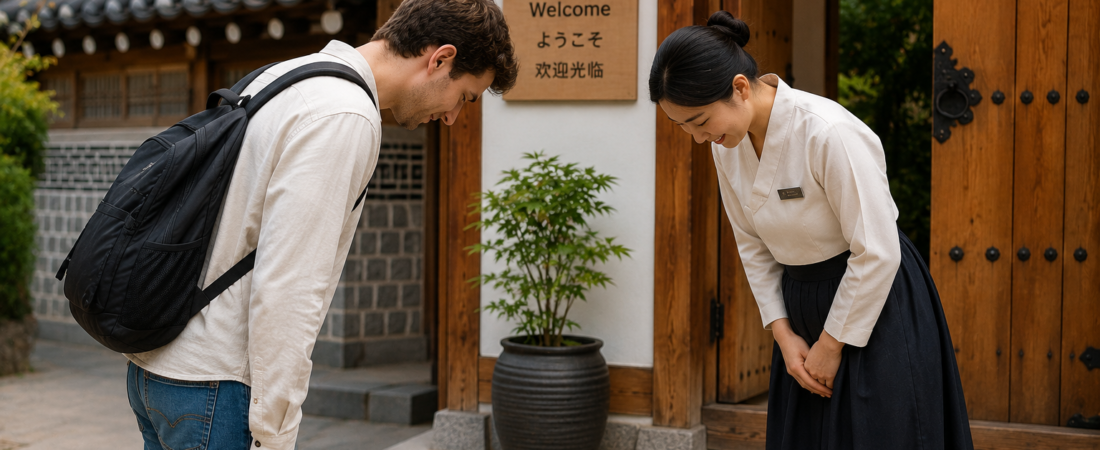
For ordinary travel in Korea, you do not need to perform a deep or formal bow.
A small bow, slight nod, or brief bend of the upper body can be appropriate in some situations. In many everyday interactions, a polite verbal greeting is just as important as the gesture itself.
The main thing is to read the context rather than memorize bow angles.
When might you bow?
You may see a small bow used when:
- greeting someone
- thanking someone
- apologizing
- saying goodbye
These are examples, not situations where every visitor is required to bow.
If someone gives you a small bow, returning it with a brief nod or small bow is a natural option. You do not need to copy the exact depth or timing.
How deep should your bow be?
For ordinary visitor interactions, keep it small and natural.
Deep formal bows belong more to ceremonial, traditional, or highly formal contexts. They are not the everyday default for shops, restaurants, hotels, or casual introductions.
You do not need a 15-degree, 30-degree, or 45-degree system for normal travel.
Do age and seniority change the greeting?
Age, seniority, and the formality of the situation can affect how polite an interaction feels.
That does not mean an older person automatically requires a deeper bow, or that a younger person must always bow first.
If the situation feels more formal, a slightly more formal greeting is usually enough for a visitor.
Do you need to bow back to staff?
You may see staff at shops, restaurants, hotels, or other service businesses use a small bow as part of a polite greeting or thanks.
You can return it with a small bow or nod if it feels natural.
But you are not required to mirror every service bow.
A polite response and normal courtesy are enough.
What about handshakes?
A handshake and a slight bow can sometimes be combined, especially in a more formal introduction.
You may also see someone support the right wrist or forearm with the left hand as a respectful gesture.
Visitors do not need to copy that gesture perfectly.
If a handshake is offered, a normal polite handshake with a small nod or slight bow is enough.
What if you forget to bow?
If you miss a bow in an ordinary interaction, continue politely.
A brief smile, verbal greeting, thank-you, or polite tone is usually enough to keep the interaction comfortable.
There is no need to turn a small missed cue into a major apology.
For broader context beyond bowing, see Korean Etiquette for First-Time Visitors.