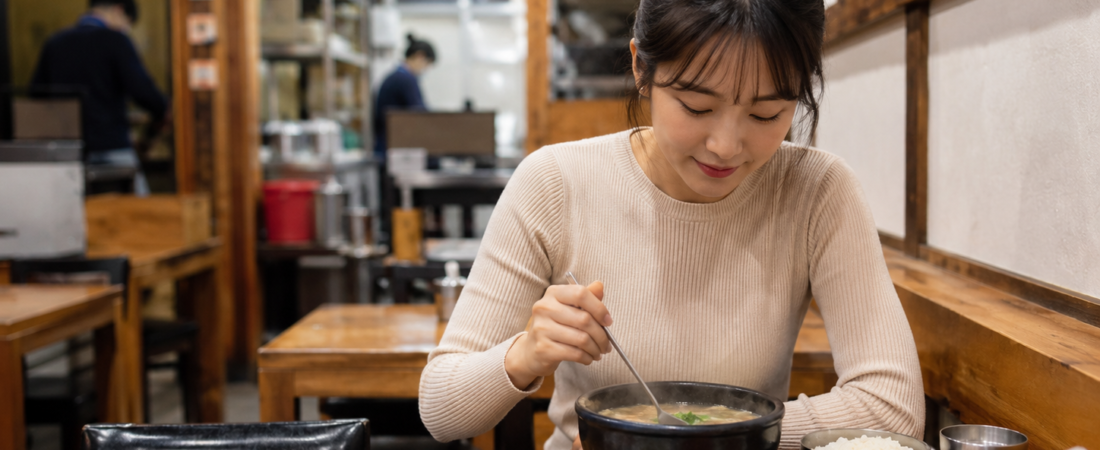
Yes. Eating alone is normal and well established in Korea today.
The more useful question is not whether solo dining is acceptable, but whether a particular restaurant and menu work well for one person.
Before sitting down, check three things:
- is the main dish sold as an individual portion or a shared dish?
- is there a minimum order?
- is the seating practical for one person at that time?
If those three points work, solo dining is usually straightforward.
Start with individual portions
The easiest solo meals are usually dishes sold as one bowl, one plate, one serving, or one individual set.
That is why options such as:
- gukbap or soup
- noodles
- rice bowls
- gimbap shops
- many bunsik dishes
- fast-food-style restaurants
- food courts
can be practical first choices.
These are examples, not guarantees. Check the actual menu.
Check the minimum order before sitting down
Some restaurants or menu items have minimum-order rules.
Look for wording such as:
- 1 serving
- 2 servings
- for 2
- set for two
- table minimum
Do not assume an entire restaurant or cuisine follows one rule.
For example, one Korean BBQ item may start at two servings while another item at the same restaurant can be ordered as a single serving.
What matters is the exact menu item, not the restaurant category.
Shared dishes are not automatically off-limits
Hot pot, jjim, dakgalbi, shabu-shabu, raw fish, or other table-cooked or shared dishes can look group-oriented.
That does not mean they are impossible for solo diners.
Some restaurants offer:
- a one-person version
- an individual set
- a single-serving alternative
- another dish that works better for one
Check the actual menu before ruling out an entire cuisine.
Check the seating, especially when it is busy
Counter seats and one-person tables are obvious positive signs, but they are not required.
A solo diner may also use an ordinary two-person or four-person table depending on the restaurant and how busy it is.
At a very crowded restaurant, especially one with only large tables, ask before assuming a table is available for one person.
If seating is awkward, that does not automatically mean solo diners are unwelcome. It may simply be a space or peak-time issue.
What if the restaurant has a two-serving minimum?
You have several simple options:
- accept the minimum if you are comfortable with it
- ask whether there is a one-person item
- choose another individual dish
- try another restaurant
A minimum-order rule should not automatically be read as a cultural rejection of solo diners.
It is usually a menu or restaurant-operation rule.
Is Korean BBQ possible alone?
Sometimes, yes.
Some Korean BBQ restaurants or meat items allow single servings, while others have two-serving or table minimums.
The same restaurant can even apply different minimums to different meat items.
So a blanket rule such as “Korean BBQ is impossible alone” or “Korean BBQ always requires two servings” is not useful.
Check the menu before sitting down.
For the actual grill-and-ordering process, see How to Eat at a Korean BBQ Restaurant.
What if the restaurant does not work for one person?
Use a practical fallback rather than forcing the situation.
If the menu is shared-only:
- ask whether there is a one-person version
- choose another individual dish
- move to another restaurant
If there is no practical seat:
- ask about another seat or counter
- choose takeout if available
- try another venue
If the restaurant is extremely crowded:
- choose a less crowded place
- return at another time if you still want that restaurant
Eating alone is normal in Korea, but the best fit is a restaurant whose menu, minimum order, and seating work for one person.