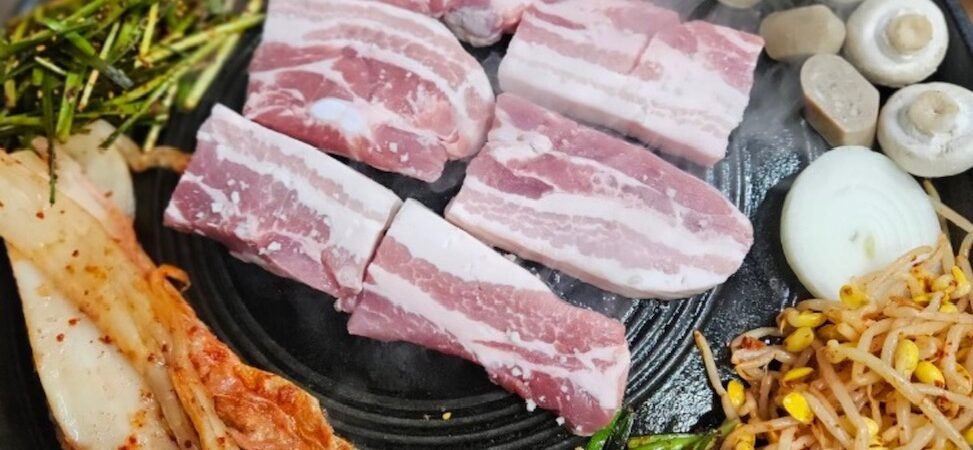
Korean BBQ is easy once you know what to check before the meat hits the grill.
For a first visit, a practical flow is:
- check the serving unit and any minimum-order note
- see whether staff or diners control the grill
- keep raw-meat tools separate from eating utensils
- cook the meat safely
- use banchan, ssam, and refills according to that restaurant’s setup
- ask staff if the grill, heat, plate, order, or payment flow is unclear
- add more meat or side dishes only if you want them
- follow the restaurant’s payment setup when you finish
There is no single Korean BBQ ritual that every restaurant follows.
Check the serving unit before you order
Before ordering meat, look at the menu for:
- the serving unit
- the weight, if listed
- any minimum-order note
Some restaurants or menu items require two servings or another minimum quantity, while other items may be available as a single serving.
A two-serving minimum should not be treated as a rule for every Korean BBQ restaurant.
Rice, stew, noodles, or other dishes are also not automatically included with the meat unless the menu says so.
If the quantity is unclear, point to the menu and confirm it before the meat is cooked.
Watch who controls the grill
Some Korean BBQ restaurants expect diners to grill the meat themselves. At others, staff may take over part or all of the cooking.
When the meat arrives, pause for a moment and see what the staff does.
If staff begins placing or turning the meat, let them lead. If the restaurant expects customers to grill, use the tools provided at the table.
If you are not sure, ask rather than taking over the grill immediately.
Keep raw-meat tools separate from eating utensils
When you are handling raw meat, use the restaurant’s cooking tongs, scissors, or other grill tools rather than your eating chopsticks.
Keeping raw-meat handling separate from the utensils you use to eat is a simple food-safety habit.
Pork and chicken should be cooked thoroughly.
If you are unsure whether the meat is ready, ask staff rather than guessing.
Use banchan and ssam the way that restaurant serves them
Korean BBQ often comes with banchan, sauces, vegetables, or ingredients for ssam wraps.
You can combine them however you like. There is no mandatory wrapping order or one correct way to eat the meat.
Refill rules vary.
Some restaurants refill basic side dishes or provide a self-service area. Others may treat certain dishes as paid add-ons.
If you want more, check whether there is a self-service station or ask staff rather than treating every side dish as free and unlimited.
Ask staff when the grill or heat becomes a problem
The grill setup is restaurant-specific.
If the heat is too strong, the plate starts burning, smoke becomes excessive, or you think the grill plate needs changing, call staff.
Some tables have a call bell. Others do not.
Use the bell if it is there, or call staff another way.
Do not dismantle the burner, hood, or grill equipment yourself to solve the problem.
Add more meat or a final dish only if you want it
You can order more meat during the meal if the restaurant allows it and you still want more.
Noodles, stew, rice, or fried rice may also be available later in the meal.
These are optional menu choices, not a required Korean BBQ ending.
The same applies to garlic, kimchi, or other ingredients that may be grilled at some restaurants.
Follow the restaurant setup and your own preference rather than treating them as part of one universal sequence.
What if you are eating alone?
Solo Korean BBQ is possible at some restaurants, but not everywhere.
A restaurant may have a minimum order, table policy, or service setup that makes solo dining easy at one place and impractical at another.
If you are dining alone, check the menu and minimum-order rule before sitting down.
For the broader question of solo dining in Korea, see Can You Eat Alone at Restaurants in Korea?.
How do you pay?
Card payment is a reasonable default at many Korean restaurants, including Korean BBQ restaurants.
Major international cards are broadly usable, but individual merchants or cards can still fail.
If one card does not work, use another payment method accepted by that restaurant.
Payment location also varies. Some restaurants expect payment at the front counter, while others may use table payment or another setup.
When you finish, follow the restaurant’s payment flow rather than assuming every place works the same way.
Tipping is generally not required or expected in Korea.
If you need broader foreign-card troubleshooting, see Can You Use a Foreign Credit Card in Korea?.