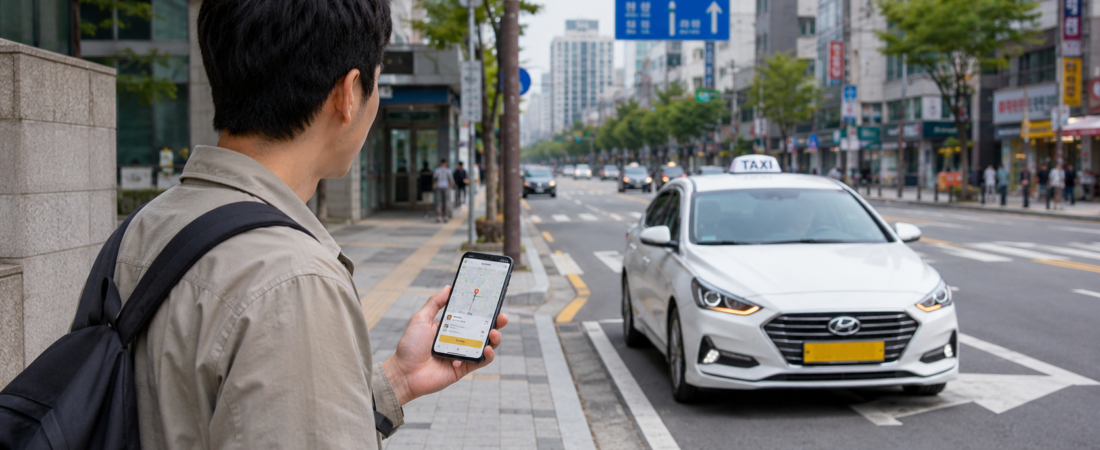
You can take a taxi in Korea by hailing one on the street, using an official taxi stand, or booking through a ride-hailing app.
For a first ride, a practical sequence is:
- choose where and how you will be picked up
- save the exact destination
- confirm the vehicle before boarding
- follow the meter or booked app fare during the ride
- check any surcharge or toll before paying
- make sure you do not pay twice for an app-paid ride
- keep the receipt or ride record until the trip is fully settled
No single taxi app, fare, color, or surcharge rule applies everywhere in Korea.
Choose how to get the taxi
Street hailing, taxi stands, and ride-hailing apps are all legitimate ways to get a taxi.
A taxi stand can be convenient at major stations, terminals, shopping areas, and other busy locations.
An app can be useful when you want the pickup point, destination, assigned vehicle, and ride record saved in one place.
You do not need one specific app to use taxis in Korea.
At airports, use the official designated taxi stand rather than accepting an unofficial solicitation.
Save the exact destination before the ride
Before requesting or boarding a taxi, save the exact Korean address or a map pin for your destination.
Not every driver will be comfortable communicating in English, so having the destination ready can make the ride simpler.
A hotel or business name can also be ambiguous if it has several branches, so the exact address is more useful than the name alone. A nearby landmark or subway station can help as a backup reference.
At a large station, airport, mall, or complex, also confirm the correct exit, pickup pin, or landmark before calling the taxi. A pickup mismatch can cause problems even when the destination itself is correct.
Confirm the vehicle before boarding
If you booked through an app, match the assigned license plate with the actual taxi before getting in.
This is especially useful at crowded pickup points where several taxis may arrive at the same time.
For a street or taxi-stand ride, make sure you are boarding a legitimate taxi from the expected pickup area.
Taxi colors and service types vary by city and provider, so color alone should not be treated as a nationwide identification rule.
Understand what the fare represents
Most ordinary taxis use a meter, while some platform, premium, or separately approved services may use a different fare plan.
For a normal street or stand taxi, check that the fare is being handled by the meter. For an app ride, follow the booked platform fare or payment information for that service.
The total can include more than the basic fare. Depending on the city, service, route, and time, possible additions include:
- a late-night surcharge
- an out-of-city surcharge
- a road toll
These rules are not identical nationwide.
If the final amount is higher than you expected, separate the meter or platform fare, any local surcharge, and any toll before assuming something is wrong.
A route that differs from your map app is also not automatically an overcharge. Traffic, road closures, one-way streets, and toll-road choices can change the route.
How do you pay?
Cash and credit cards are widely used for taxi payment, and foreign-issued credit cards are supported through many taxi card readers and major ride-hailing services.
Some local systems also support transportation-card payment, but payment methods vary and Tmoney should not be assumed to work in every taxi nationwide.
If one foreign card fails, try another supported payment method rather than assuming foreign cards do not work in Korean taxis.
For more detail on where foreign cards work and what to do when a payment fails, see Can You Use a Foreign Credit Card in Korea?.
For an app ride, check whether the fare has already been charged in the app before paying the driver. This helps avoid accidental double payment.
Keep the receipt or app ride record
Keep the receipt or app ride history until you have:
- checked the fare
- confirmed the payment is complete
- checked that you have all your belongings
A receipt or digital ride record can preserve useful information about the trip and vehicle.
That can help if you later need to question the fare or recover something left in the taxi.
What if the pickup, fare, or ride seems wrong?
If the driver appears to be heading somewhere unexpected, compare the route with your map and confirm the destination again.
A different route does not by itself mean something is wrong.
If you have a genuine fare or service concern, keep the receipt, app history, and vehicle information.
Complaint systems vary by city, so use the relevant local taxi authority or the app or operator support channel.
Seoul has its own multilingual complaint channels, but those should not be treated as the nationwide process.
If an app cannot find a taxi, that also does not automatically mean a driver has illegally refused the ride.
Try another legitimate booking method, a taxi stand, or a clearer pickup point.
What if you leave something in the taxi?
First, check your receipt or app ride history for the ride and vehicle information.
Then contact the ride-hailing service, taxi operator, or relevant local taxi support channel.
If the item is not recovered through the operator, Korea’s police Lost112 lost-and-found system is another nationwide route to check.
The simplest precaution is to keep the ride record until you have checked your belongings after getting out.