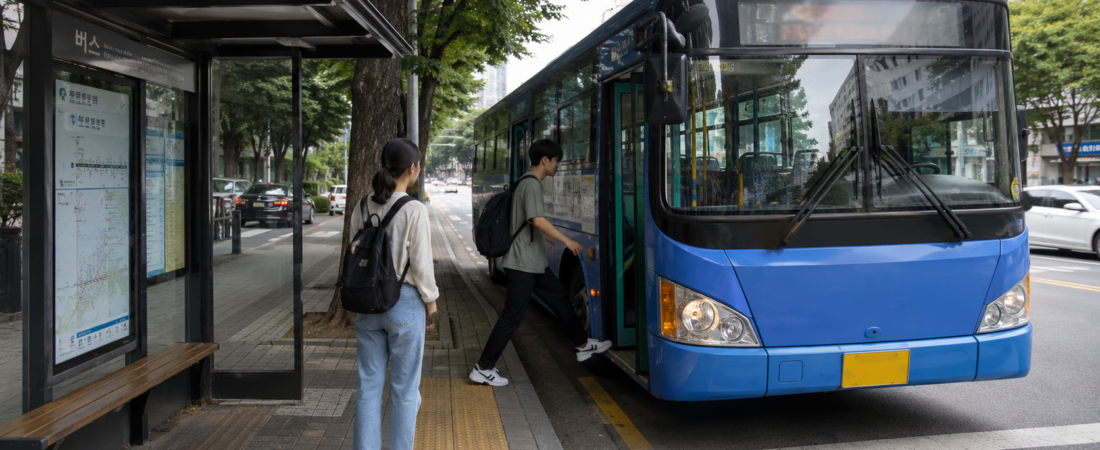
Using a local bus in Korea gets much easier once you focus on the right sequence: find the correct stop, confirm the direction, verify the arriving bus, tap when boarding, watch for your stop, press the stop bell, and tap again when getting off if the local system requires it.
A Korea-wide first-use flow looks like this:
- find the correct stop for your direction
- confirm the route and arriving bus
- board and tap your transportation card
- monitor the next-stop information
- press the stop bell before your stop
- get off and tap again where the local system requires it
- re-route if you boarded the wrong bus or missed your stop
The details of cash payment, transfer rules, door use, and last-bus times vary by city and route.
Check the stop and direction, not just the bus number
A bus number by itself is not enough.
Before boarding, confirm that you are standing at the correct stop for the direction you want to travel.
Bus-information systems can show route numbers, stops, arrival information, current vehicle locations, and direction. Use the stop display, an official bus-information service, or a map or transit app to confirm the bus before it arrives.
You do not need one specific app. The important thing is to verify the stop, route, and direction together.
How do you board and pay?
A common pattern is to board through the front door and tap your transportation card near the driver.
Treat this as a useful default rather than a nationwide rule. Door use can vary by city, route, or operating condition.
For local buses, a transportation card is the most practical default payment method.
Cash rules vary. Some city-bus systems are cashless, while others still allow cash fares.
For buying and loading a standard physical Tmoney card, see How to Buy and Use a Tmoney Card in Korea.
How do you know when to get off?
While riding, watch or listen for the next-stop information and compare it with your route map when possible.
When your stop is next, press the stop bell before the bus reaches it.
The bus may not stop at every stop unless a passenger needs to board or get off.
Onboard displays and announcements are useful on many major-city buses, but English support is not guaranteed on every route or vehicle.
Should you tap your card again when getting off?
When using a transportation card, tap again when getting off unless the local operator instructs otherwise.
The exit tap can matter for fare calculation or transfer processing.
Detailed transfer rules—such as time windows, number of transfers, and eligible routes—vary by city.
For a Korea-wide guide, the practical rule is to tag correctly when boarding and getting off, while treating detailed transfer rules as local.
What if you board the wrong bus?
If you realize you are on the wrong bus, get off at the next safe stop.
Then:
- check your current location
- confirm the route and direction again
- find the correct opposite-direction or alternative route
- continue from there
The opposite-direction stop may not be directly across the road.
There is also no nationwide rule guaranteeing that a mistaken bus ride will preserve a transfer discount or qualify for a special correction.
What if you miss your stop?
If the bus passes your destination, get off at the next safe stop and re-route.
Check the stop and direction again before boarding another bus.
This is more reliable than assuming every route has a simple turnaround point or that the return stop is nearby.
What should you know about the last bus?
There is no single nationwide last-bus time.
Last-bus times vary by route, city, day, and service conditions.
If you are traveling late, check the current route information for that specific bus rather than relying on a generic rule.
Traffic can also affect bus arrival times, so real-time information is especially useful.
What about crowded buses?
Urban buses can be crowded during commuting periods.
If you are carrying luggage or prefer more space, traveling outside the busiest times can be more comfortable when your schedule allows.
There is no single Korea-wide rush-hour window, so treat crowding as a route- and city-specific timing issue rather than a fixed national schedule.