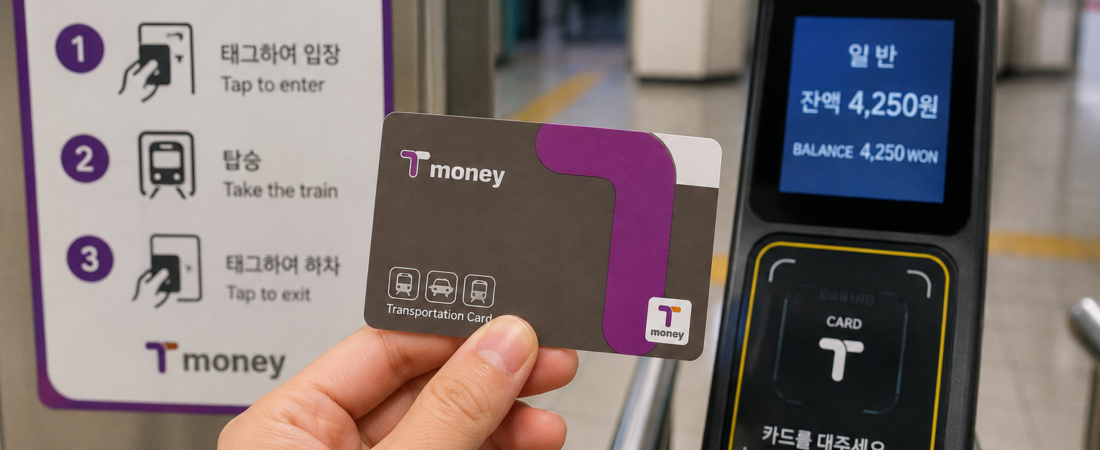
A Tmoney card is one of Korea’s main prepaid transportation cards. It works widely across public transportation beyond Seoul and can also be used at some participating shops and other merchants.
For most short-term visitors, the simplest way to think about it is:
- buy a standard physical Tmoney card
- load Korean won onto it
- tap when using transit
- keep enough balance for the next ride
- use or refund the remaining balance before you leave if useful
The important detail is that the price of the physical card and the money stored on it are separate.
Where can you buy a Tmoney card?
A standard physical Tmoney card is commonly sold at participating convenience stores across Korea.
You can also buy one at customer-service or information offices in parts of the Seoul metropolitan subway system.
Common convenience-store chains that sell Tmoney include GS25, CU, 7-ELEVEN, emart24, and StoryWay.
Availability can vary by branch, so a particular store may not always have the card or design you want in stock.
The card price and the balance are different
When you buy a physical Tmoney card, you are paying for the card itself.
That purchase price is not automatically your transportation balance.
You then load separate stored value onto the card for fares or other eligible payments.
The card price can vary by design or product, so it is better not to rely on one permanent nationwide price.
How should foreign visitors top up Tmoney?
For the standard physical Tmoney route used by most visitors, keep some Korean won cash available for purchase and top-up.
Current visitor guidance says foreign-issued credit cards are not accepted for ordinary Tmoney purchase or top-up through the usual convenience-store and subway-station channels.
That does not mean every Tmoney-related product or service uses the same payment method. Mobile Tmoney and special products can work differently.
For a first trip, the practical rule is: if you are using a standard physical Tmoney card, expect to use cash when loading it through normal tourist channels.
If you are deciding how much backup cash to keep, see Do You Need Cash in Korea?.
How do you use Tmoney on the subway?
Tap your Tmoney card when you enter the subway and again when you exit.
Both taps matter for correct fare processing.
Detailed subway navigation, transfers, directions, and platform use belong in the full subway guide: How to Use the Subway in Korea.
How do you use Tmoney on buses?
On city buses, tap when boarding and tap again when getting off.
The exit tap can matter for fare and transfer processing.
Transfer rules are not identical across Korea. Timing, eligible routes, and fare logic can vary by city, so Seoul’s detailed transfer rules should not be treated as nationwide rules.
For the full boarding and exit process, see How to Use a Bus in Korea.
What if the balance is too low?
Tmoney is prepaid, so the card needs enough stored value for the fare or payment you are trying to make.
If the balance is insufficient, top up the card at an available charging point and try again.
An insufficient-balance message does not necessarily mean the card itself has failed.
It is also useful to leave enough value on the card for your next ride rather than running the balance down to almost zero every time.
Can you use Tmoney for anything besides transit?
Yes, at participating locations.
Tmoney can also be accepted at some taxis, convenience stores, shops, vending machines, and other affiliated merchants.
Look for Tmoney acceptance rather than assuming every taxi, store, or vending machine supports it.
Can you refund the remaining balance?
Yes. Remaining Tmoney balance can be refunded through eligible outlets.
The exact refund location depends on the remaining balance and the type of Tmoney product, and operational thresholds or fees can change.
For an evergreen rule, think of it this way: small balances may be handled through common service outlets, while larger or special refunds may require a designated Tmoney service location.
Check the current Tmoney guidance if you expect to request a large refund.
Also remember that the original purchase price of the physical card and the stored balance are separate things.
What if you lose the card?
Treat an ordinary, unregistered physical Tmoney card like cash.
If you lose it, do not assume the remaining balance can be recovered.
Registered, mobile, or special Tmoney products may have different protection or recovery features, but those should not be confused with the standard physical card most visitors buy.
If a physical card is damaged but still readable, some refund or balance-transfer options may exist depending on the card and service location. Do not expect instant recovery everywhere.