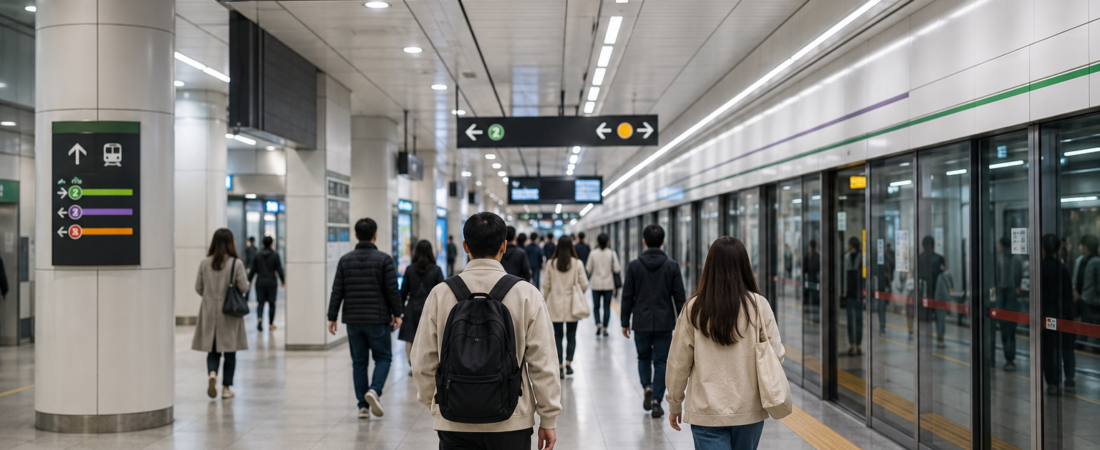
Using the subway in Korea is straightforward once you focus on the right sequence: plan the route, check the train direction, follow transfer signs, and confirm your exit before you go above ground.
A Korea-wide first-use flow looks like this:
- confirm your starting station and destination
- check any transfer station
- check the train direction or terminal
- use a valid transit card or local ticket at the gate
- follow transfer signs if needed
- exit at your destination
- use the correct exit number
The details of fares, single-use tickets, transfer discounts, and re-entry rules vary by city.
Plan your route before entering the station
Before you pass through the gate, confirm:
- your departure station
- your destination
- any transfer station
- the train direction or terminal
- the exit number you want at the end
Korea has subway systems in several major cities, and current route tools cover Seoul, Busan, Daegu, Gwangju, and Daejeon.
You do not need one specific app to use the subway. What matters is having a route source that shows the stations, transfers, direction, and current train information you need.
If you are traveling late, also check the last train for your actual route, day, and direction rather than relying on a generic closing time.
Use a valid transit card or ticket at the gate
Use Tmoney or another locally valid transit card or ticket to enter the paid area.
If you do not have a transportation card, local single-ride options are also available, but the ticket format differs by city.
One city’s single-use ticket system should not be treated as a nationwide standard.
If the gate does not open, stop and get help rather than repeatedly tapping the card or guessing what the error means.
For buying and loading a standard physical Tmoney card, see How to Buy and Use a Tmoney Card in Korea.
Check the direction, not just the line
Finding the correct line is only half the job.
Before boarding, check the direction or destination shown for the train.
Two trains on the same line can travel in opposite directions, and some lines may also have branches, different terminal destinations, or express services.
When those variations exist, check the train itself before boarding rather than assuming every train on that platform serves your stop in the same way.
Follow transfer signs and check the next direction again
At a transfer station, follow signs for the next line.
Then check the direction or terminal again before you enter the next platform.
Line numbers, colors, and English station names can be useful navigation aids, but the exact signage system varies by city and operator.
Detailed transfer-fare rules also vary by system, so a Seoul transfer rule should not be treated as if it applies everywhere in Korea.
Check your exit number before you go above ground
Large subway stations can have many exits leading to different sides of a road, intersection, or neighborhood.
Check the exit number before you head toward the surface.
Choosing the right exit can save an unnecessary walk around a large station or intersection.
If you are carrying luggage or need step-free access, check the specific station and exit in advance rather than assuming every exit has an elevator.
What if you take the wrong train or enter the wrong side?
If you realize you are going in the wrong direction, get off at a suitable station and return in the opposite direction if the paid-area layout allows it.
Some stations let you reach the opposite platform without leaving the paid area. Others do not.
There is no single Korea-wide free re-entry rule.
If you cannot correct the mistake without exiting, ask station staff or use the local help facility and follow that system’s re-entry or correction rule.
A Seoul-specific re-entry policy should not be treated as a nationwide rule.
What if the gate or card does not work?
A gate can fail to open for several reasons, including a card-reading problem, insufficient balance, or an invalid entry or exit state.
The exact error message and correction process vary by system.
A practical response is:
- stop rather than repeatedly tapping
- check that you are using a valid card or ticket
- use the station help point, call button, or staff assistance if available
- follow the local correction instructions
If the problem is simply insufficient Tmoney balance, top up the card and try again.
What should you know about rush hour?
Subways can be very crowded during weekday commuting periods.
If your schedule is flexible and you are carrying luggage or prefer more space, traveling outside the busiest commuting times can be more comfortable.
There is no single Korea-wide rush-hour window, so treat crowding as a practical timing issue rather than a fixed national timetable.