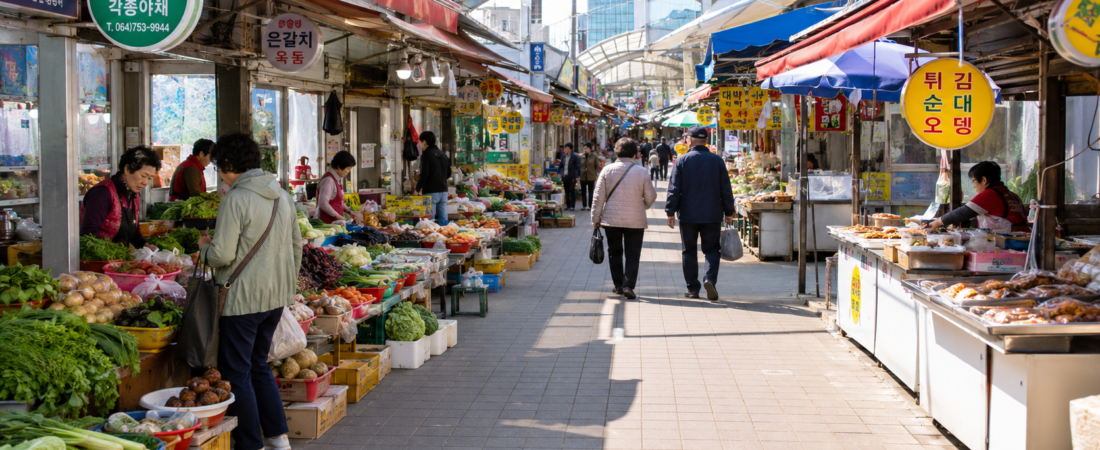
Traditional markets in Korea are easy to enjoy once you know what to check before you buy, eat, or sit down.
For a first visit, a practical flow is:
- check the market and stall hours
- save a useful entrance, zone, or landmark
- confirm the price and quantity before ordering
- check the payment method before committing
- see whether bargaining is appropriate in that situation
- confirm whether food is dine-in, takeout, standing, or shared seating
- check restrooms, storage, or navigation help only if you need them
- use simple fallbacks if the first stall, seat, or payment method does not work
Traditional markets are not one fixed operating model. Tourist markets, neighborhood markets, food streets, indoor arcades, outdoor streets, and periodic markets can all work differently.
Check the market and stall hours before you go
Traditional-market hours vary by market, section, and individual store.
A market may publish general opening hours while food streets, restaurants, or individual stalls follow different schedules.
Check the market’s official information before you go, but expect some shops to open later or close earlier than the market as a whole.
There is no single nationwide opening or closing schedule for traditional markets.
Save a useful entrance, zone, or landmark
Large markets can be confusing once you move away from the main entrance.
Before wandering deep inside, save:
- the market name
- the entrance or gate you used
- a nearby landmark
- a notable shop, street, or zone
Some markets have maps or information desks, while others do not.
If you get turned around, returning to a saved entrance or landmark is usually easier than trying to remember every aisle.
If you are carrying large luggage, check whether the market or a nearby station has storage before arriving. The market itself may not have lockers.
Check the price and quantity before ordering
Before buying food or goods, look for the posted price and, where relevant, the portion, quantity, or weight.
Not every stall displays information in the same way.
If the amount or total is unclear, ask before the seller starts preparing, cutting, weighing, or packing the item.
This is especially useful for food portions, weighed goods, or items sold in different sizes.
Traditional markets are not automatically cheaper than supermarkets or restaurants, so judge the actual item and price in front of you.
Check the payment method before committing
Traditional markets in Korea are not uniformly cash-only.
Many sellers accept cards, especially at larger or tourist-facing markets, but payment can still vary by stall.
A practical approach is:
- use a card where it is accepted
- keep a small amount of Korean won as backup
- confirm payment before ordering if you are unsure
A foreign-issued card may still fail at a particular stall, and there is no single nationwide minimum card amount.
If your card does not work, use another payment method accepted by that seller rather than treating it as a general rule about market payments.
Bargaining is not automatically expected
Bargaining is not a universal rule at Korean traditional markets.
Many sellers use posted or quoted prices, and current market programs increasingly emphasize fixed pricing and price transparency.
Check the displayed or quoted price first.
If the seller clearly invites negotiation, the situation may be different. Otherwise, there is no need to start every purchase by assuming you are expected to haggle.
Check whether food is dine-in, takeout, or shared seating
Market food does not all work the same way.
Depending on the market and seller, you may find:
- stools beside a stall
- restaurant-style seating
- standing areas
- shared market seating
- takeout-only service
Before sitting down, check whether the seat belongs to the stall where you bought the food or is genuinely shared.
An empty seat is not automatically public seating.
If you are not sure, ask the seller before carrying food from one stall into another seating area.
Check facilities only when you need them
Some traditional markets have restrooms, information desks, multilingual support, or other visitor facilities.
Others may rely more on nearby public facilities or transit stations.
Restrooms, English-speaking staff, ATMs, luggage storage, and multilingual signs should all be treated as market-specific rather than guaranteed.
If you need a restroom, use the market map or official listing when available.
If you need luggage storage, check the specific market or nearby station and see How to Use Luggage Lockers in Korea for the storage process itself.
What if the first option does not work?
Traditional markets are flexible places, so most small problems have simple fallbacks.
If a stall does not accept your card:
- use another accepted payment method
- try another seller if needed
If seating is full or unclear:
- ask whether there is shared seating
- switch to takeout
- choose another stall or food area
If you get lost:
- return to your saved entrance or landmark
- use an information desk if the market has one
- check your map again from a known point
If a food order or quantity is unclear:
- stop and confirm the price and amount before preparation goes further
The practical approach is to check the market, stall, price, payment, and seating setup in front of you rather than assuming every traditional market works the same way.