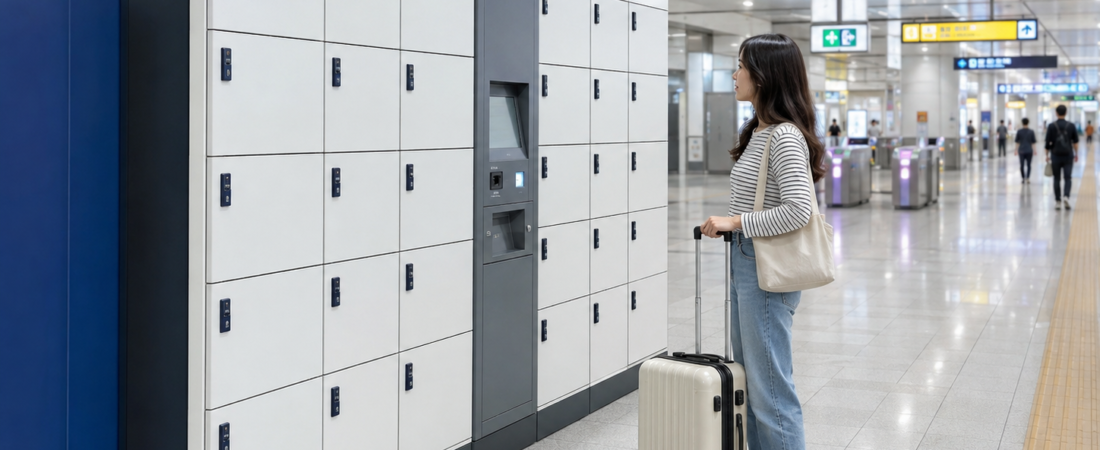
Luggage lockers are useful in Korea, but the important thing is not just finding one. You also need to check whether your bag fits, how that specific locker takes payment, how you will retrieve it, and when you can get back to it.
For a first-time user, a practical sequence is:
- confirm that storage exists at the station or facility
- save the exact locker location
- check that your bag fits before paying
- follow that machine’s payment and access instructions
- make sure the locker is actually secured
- save the retrieval information
- check the access hours before you leave
If the locker is full, too small, or does not work with your payment method, look for another locker area or staffed luggage storage.
Confirm that the station or facility actually has lockers
Stations and terminals are good places to look for luggage storage, but lockers are not guaranteed at every location.
Large stations may have several locker areas, while smaller stations may have only a few or none.
Before depending on a locker, check the specific station or facility information when possible. If you are already there, look at the station map or ask staff.
Airport baggage storage can work differently from subway or railway-station lockers, so the same system or procedure should not be assumed everywhere.
Save the exact locker location
This is easy to overlook in a large station.
Before walking away, save or photograph:
- the locker number
- the station or facility name
- the floor
- the exit, zone, or nearby landmark
- any receipt, code, QR record, or app information used for retrieval
A large station can have more than one locker bank. Remembering only the station name may not be enough when you return.
Check that your bag fits before paying
Locker sizes vary by operator and machine.
Labels such as Small, Medium, or Large may be used, but the actual dimensions are not standardized nationwide.
If you have a large suitcase, compare the real locker opening or posted dimensions with your bag before paying.
A locker labeled “Large” will not necessarily fit every large suitcase.
If your bag is too large, staffed luggage storage may be a better option.
Follow the payment and access instructions on that locker
There is no single payment method or interface used by every luggage locker in Korea.
Depending on the operator, the system may use an app, kiosk, card, code, receipt, QR record, or another access method.
Payment support can vary, so check whether the specific locker accepts the method you plan to use, such as Tmoney, cash, a foreign-issued credit card, or a mobile-payment option.
A Korean phone number is also not a universal requirement for every locker system.
Use the instructions shown on the specific machine or operator service, and make sure you understand how you will open the locker later before leaving your bag.
Confirm that the locker is actually secured
After placing your luggage inside, close the door and confirm that the storage transaction has completed.
A closed door by itself is not enough confirmation.
Check whatever confirmation that system provides—such as an app record, receipt, screen message, or access credential—and keep it until you retrieve your bag.
If the door or lock does not behave as expected, use the posted operator support channel or ask station or facility staff rather than guessing at a reset procedure.
Check the access time before you leave
A locker can exist even when you cannot access it at all hours.
Operating and retrieval hours depend on the locker operator and the building or station where it is located.
Some systems also charge extra when luggage is stored beyond the base period, and long-uncollected items may be handled under separate operator rules.
Before leaving, check:
- when you can physically return to the locker
- whether extra time adds a charge
- whether there is a storage deadline that matters to your trip
Locker availability should not be treated as a guarantee of 24/7 access.
What if the locker is full or something goes wrong?
If the first locker option does not work, you still have several practical fallbacks.
Try:
- another locker bank in the same station or facility
- another nearby storage location
- staffed luggage storage
- station or facility staff if the locker has a door, payment, or retrieval problem
A full locker bank does not necessarily mean every locker in the station is full.
For an error, keep the locker number and your payment or access record so the operator or staff can identify the transaction.
For oversized luggage, staffed storage is often more practical than forcing the bag into a locker that does not fit.
This article covers the storage process itself. For the transport journey around it, see How to Use the Subway in Korea or How to Take the KTX in Korea.