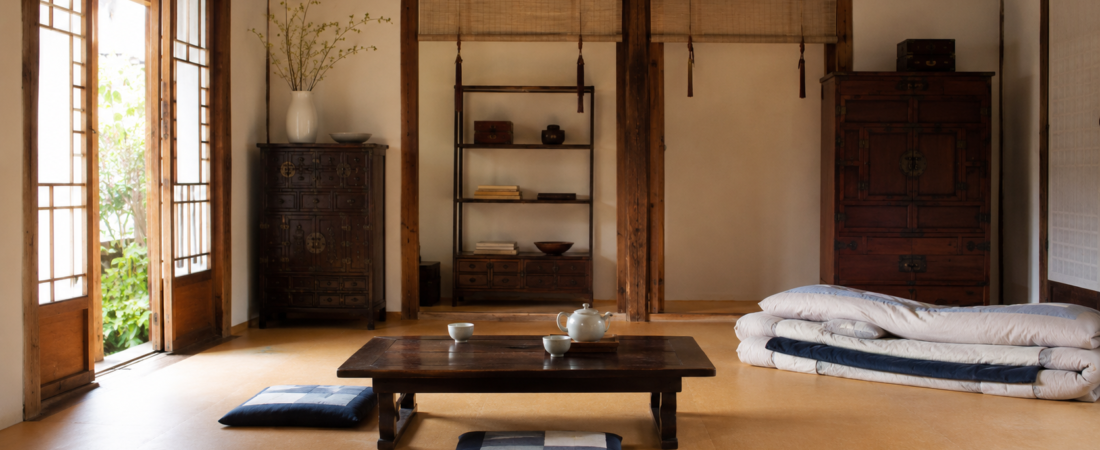
Koreans do not all sit on the floor in everyday life today. Modern homes commonly use chairs, sofas, dining tables, and beds.
But floor-level living remains an important part of Korean culture because traditional homes were built around ondol, Korea’s underfloor-heating system. A warm floor was not just something to walk on—it could also be used for sitting, eating, resting, and sleeping.
Ondol is a major reason floor-level living became so deeply rooted in Korea, but it is not the only explanation. Housing layout, furniture habits, multipurpose rooms, and long-standing indoor customs also shaped the way people used the floor.
Ondol made the floor part of the living space
Traditional ondol heated the floor from below.
That made the floor itself a comfortable living surface, especially in colder weather.
In traditional Korean rooms, the same space could be used for several purposes during the day. People might sit, eat, rest, or sleep on the floor rather than assigning separate furniture to each activity.
This is why Korean floor culture is better understood as floor-level living, not simply as a habit of sitting low.
Ondol was important, but it does not explain everything
It would be too simple to say Koreans sit on the floor only because of ondol.
Traditional room layouts, low furniture, multipurpose use of rooms, indoor shoe-removal habits, and long-term social customs all developed alongside heated-floor living.
These factors reinforced one another over time.
So ondol is one of the strongest historical explanations, but not a single complete cause for every Korean floor-sitting custom.
Modern Korean life is much more chair-based
Modern Korean homes are not exclusively organized around floor sitting.
As housing changed, especially with apartment living, beds, sofas, dining tables, and chairs became normal parts of everyday life.
Underfloor heating still remains common, so the warm-floor tradition did not disappear. What changed was how people furnished and used the space above it.
Some households still sit, relax, or eat on the floor at times, while others mainly use conventional chairs and tables.
There is no useful rule such as “Koreans today mostly sit on the floor.”
Where might a visitor still encounter floor seating?
You may still encounter floor-level seating in places such as:
- some traditional restaurants or teahouses
- some hanok accommodations
- some homes
- cultural programs
- some jjimjilbang relaxation areas
But none of these settings guarantees floor seating.
A traditional restaurant may have chair seating, floor seating, or both. A hanok stay may offer an ondol room with floor bedding, a room with beds, or a mix of traditional and modern furniture.
Check the actual venue or room type instead of assuming that “traditional” automatically means sitting or sleeping on the floor.
What should you do if floor seating feels awkward?
First, look at how the space is set up.
If there is a shoe rack, raised floor, entrance step, cushion, or staff instruction, follow those cues. Detailed shoes-off rules belong to Why Do Koreans Take Their Shoes Off Indoors?, but the local setup is usually the best signal.
If a cushion is provided, use it.
There is no single “correct Korean sitting posture” that a visitor must copy. Sit in a stable position that works for you and change position when needed.
If floor seating is uncomfortable, ask whether chair or table seating is available. Some traditional spaces provide both, although chair seating should not be assumed everywhere.
For a hanok stay, checking the room type before booking is the easiest way to avoid a floor-sleeping setup you do not want.