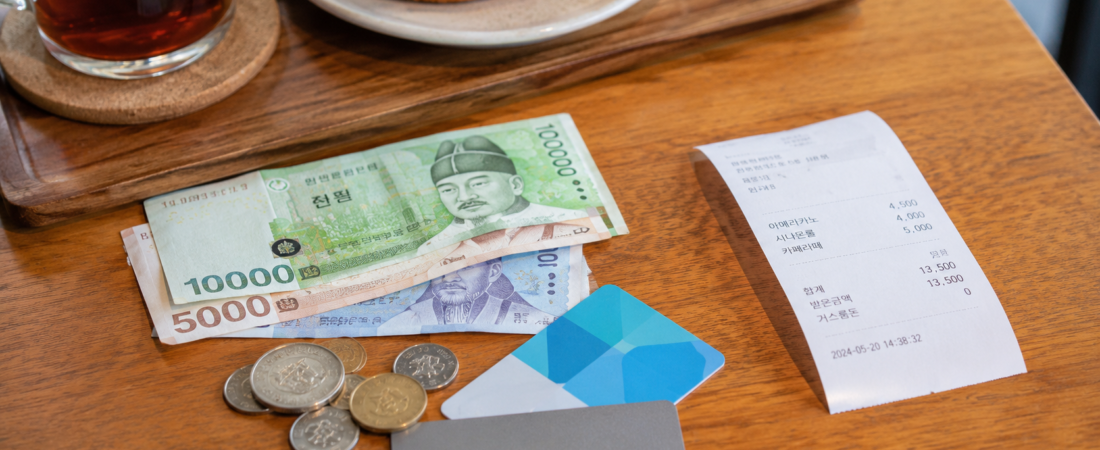
You probably do not need to carry much cash in Korea. Korea is highly card-friendly, and most ordinary urban spending can be handled by card.
Still, keeping a small amount of Korean won as backup is useful. Cash can matter at some traditional-market or street stalls, for standard Tmoney purchase or top-up, and when a foreign-issued card does not work as expected.
There is no single cash amount that every visitor needs. A better question is which parts of your own trip may still require cash.
When is cash useful?
For everyday spending at restaurants, cafés, convenience stores, hotels, department stores, and other mainstream businesses, a card-first approach is reasonable.
Foreign-issued cards are widely usable in many traveler-facing situations, but no card works everywhere. Payment conditions can vary by merchant, machine, and service.
Cash is especially useful as a backup for situations such as:
- a traditional-market or street-stall seller that does not accept your card
- a small merchant where your foreign-issued card fails
- a payment machine or service with different international-card support
- a transit-card purchase or top-up that requires Korean won
Traditional markets are not uniformly cash-only. Many sellers accept cards, so the useful point is simply that payment methods can vary from stall to stall.
If your foreign card is declined, try another card if you have one. If you need cash, use an ATM that explicitly supports your card’s international network rather than assuming every ATM accepts foreign cards.
For the withdrawal process itself, see How to Withdraw Cash from an ATM in Korea with a Foreign Card.
What about public transportation?
Cash is still useful for one specific traveler situation: standard Tmoney purchase and top-up.
Current visitor guidance says that through the usual convenience-store and subway-station route, foreign-issued credit cards are not accepted for standard Tmoney purchase or top-up. For an international visitor using that route, Korean won cash is therefore useful.
That does not mean transportation in Korea is generally cash-only. Payment methods vary by service and machine.
The important distinction is that ordinary card spending and Tmoney top-up do not always work the same way.
For the full purchase, charging, and use process, see How to Buy and Use a Tmoney Card in Korea: A Simple Guide.
How much cash should you carry?
There is no official nationwide recommendation telling visitors to carry a fixed amount such as KRW 50,000 or KRW 100,000.
Instead, think about what you expect to use cash for.
A practical amount is enough to cover:
- the Tmoney purchase or top-ups you expect to make
- a few purchases where only cash is accepted
- a short-term backup if one of your cards does not work
If your itinerary is mostly hotels, cafés, restaurants, major shops, and other card-friendly places, your cash needs may be small.
If you plan to spend more time at markets, street stalls, or places where payment methods are uncertain, you may want a little more backup cash.
The goal is not to carry a large cash reserve. It is to have enough Korean won that one failed card transaction does not disrupt your plans.
Should you exchange a lot of money before your trip?
Usually, no.
Because Korea is highly card-friendly, you do not need to exchange a large amount of money simply because you are visiting.
Starting with a modest backup amount is more practical than choosing an arbitrary large cash budget. If you later need more Korean won, a compatible international-network ATM can provide another option after arrival.
When paying by card or withdrawing cash, you may sometimes be offered conversion into your home currency. This is Dynamic Currency Conversion (DCC).
If you are given that choice, check the conversion carefully. Paying in KRW avoids the merchant or ATM’s DCC conversion and leaves the currency conversion to your card network or issuer.
Your own card may also charge overseas or ATM fees, so check your issuer’s terms rather than assuming one fee applies to every foreign card.
Wondering where your overseas card is likely to work? Read Can You Use a Foreign Credit Card in Korea? A Simple Guide.