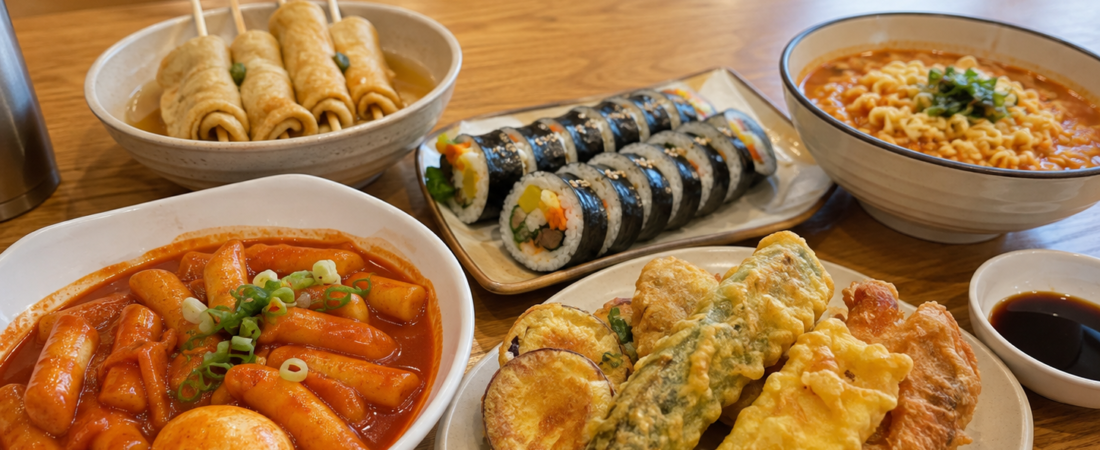
Bunsik is a casual Korean food category built around simple, convenient meals.
The word originally referred to flour-based foods, but today it covers a much broader range of everyday dishes.
Common examples include tteokbokki, gimbap, twigim, sundae, eomuk, and ramyeon.
Bunsik overlaps with Korean street food, but the two are not the same thing. You can eat bunsik at market stalls, small seated restaurants, gimbap shops, chains, takeout-focused stores, and self-service restaurants.
For a first visit, the practical approach is to see how that particular shop works before ordering.
Check how the shop takes orders
There is no single bunsik ordering system.
Depending on the shop, you may order at a counter, kiosk, table, with an order slip, or through a self-service setup.
Look for the counter, kiosk, menu board, order slip, or table instructions before deciding what to do.
Payment timing also varies. Some places take payment when you order, while others settle the bill after the meal.
The important thing is to check how the shop takes the order and whether you pay now or later.
Choose from the menu that shop actually has
A bunsik shop does not need to sell every famous bunsik dish.
One place may focus on gimbap and ramyeon, while another may specialize in tteokbokki, twigim, or a smaller set of dishes.
Tteokbokki is often spicy, but recipes and spice levels vary. Non-spicy or milder versions also exist.
Do not assume a dish is vegetarian or vegan from its appearance or name. Gimbap can contain egg, ham, tuna, or crab-flavored filling, and tteokbokki may include fish cake or animal-derived broth ingredients.
If spice level or ingredients matter to you, ask rather than guessing.
Card payment is common, but check the shop
Card payment is widely used in Korea, and many bunsik restaurants accept cards.
That does not mean every small shop accepts every foreign-issued card or every payment method.
If you are unsure, check before ordering.
If one card does not work, use another payment method accepted by that shop rather than treating it as a general rule about bunsik restaurants.
For broader foreign-card acceptance and payment troubleshooting, see Can You Use a Foreign Credit Card in Korea?.
Keep your receipt or order number until the food arrives
Pickup and serving methods vary just as much as ordering.
Your food may be brought to the table, called by number or name, shown on a screen, collected at the counter, or handled through a self-service system.
Keep the receipt or order number until you have received the food.
If the order seems wrong or you miss the pickup call, that record makes it easier for staff to find the order.
Follow the shop’s self-service setup
Water, utensils, danmuji, kimchi, broth, and other side items may already be on the table, be provided by staff, or be available from a self-service area.
The same goes for tray return. Some shops have a marked return station; others clear the table themselves.
Side items should not automatically be treated as free, unlimited, or self-service.
Follow the setup in front of you.
Is bunsik good for eating alone?
Bunsik can be practical for solo dining because many dishes are sold as individual portions.
But it is not automatically solo-friendly everywhere.
Some shops may have shared pots, set menus, limited seating, or minimum-order rules.
If you are eating alone, check the menu and ordering setup before committing.
For the broader question of solo dining, see Can You Eat Alone at Restaurants in Korea?.
What if there is no seat or something goes wrong?
Many bunsik and gimbap shops offer takeout, but not every shop or menu guarantees it.
If there is no seat, check whether another seating area exists, ask whether takeout is available, or choose another shop.
If the order or quantity is wrong, compare the receipt or order screen and tell staff as soon as possible.
If a kiosk does not work, use a staffed counter if one is available.
If a card is declined, try another payment method accepted by the shop.
If the food is spicier than expected, ask whether a milder dish is available rather than assuming the restaurant can remake or refund the order.
The practical lesson is that bunsik is a flexible food category, so the best first-use habit is to read how that specific shop orders, serves, and handles payment.