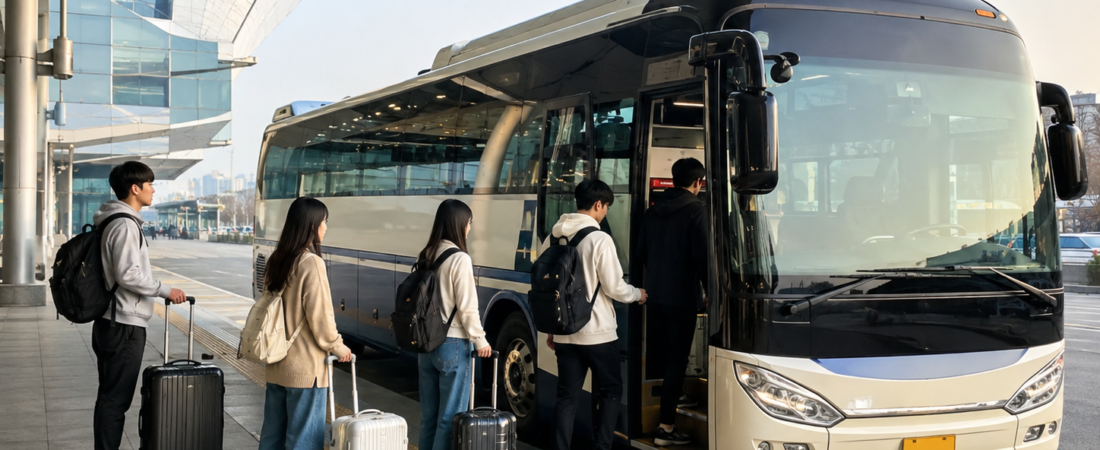
Taking a long-distance bus in Korea is straightforward once you get three things right: the bus type, the exact terminal, and the exact service you booked.
Express buses and intercity buses are related, but they are not the same. Express buses are generally more direct long-distance services, while intercity buses may make intermediate stops and often reach smaller regional destinations.
For a first trip, focus on this sequence:
- confirm whether the route is express or intercity
- check the exact departure and arrival terminal
- book the correct route and check the ticket format
- match the live terminal board to your destination, time, and platform
- confirm the bus and seat before boarding
- pay attention to intermediate or rest-area stops during the trip
If something goes wrong, use the official change, rebooking, or staff-assistance process for that service.
Check whether the route is express or intercity
Express buses and intercity buses share a similar traveler workflow, but their route patterns can differ.
Express buses are typically long-distance services using expressways and generally do not make intermediate city stops.
Intercity buses may use expressways or national highways, can make intermediate stops, and may serve smaller cities or towns that are not conveniently reached by rail.
You do not need to memorize the full service taxonomy. You do need to know which type you booked, because the terminal and booking channel can differ.
Confirm the exact departure and arrival terminal
A city can have more than one long-distance bus terminal, and express and intercity services may use different terminals. In Seoul and some other cities, those terminals can also be far apart.
Before leaving for the terminal, check:
- the exact departure terminal name
- the terminal location on your map
- the exact arrival terminal or stop
- the departure time
Do not rely on the city name alone.
If you arrive at the wrong terminal, ask staff what options remain and follow the appropriate change or rebooking process. There is no nationwide correction rule for a wrong-terminal mistake.
Book the correct route and check your ticket format
Current booking channels include KOBUS for express buses and TxBus or Bustago for intercity buses.
Multilingual booking channels for international visitors are also available for some routes and services.
Foreign-issued credit cards are supported through many current traveler-facing ticket machines, counters, and selected online booking channels, but no single card or channel is guaranteed to work every time.
You can also buy a ticket at the terminal if seats are still available.
After booking, check one more thing: is your reservation itself the boarding ticket, or do you still need to issue or print a ticket at the terminal?
That can vary by route and booking method.
Use the live departure board at the terminal
Once you arrive, do not rely only on the confirmation you saved earlier.
Match your booking with the current terminal departure information:
- destination
- departure time
- platform
- bus or service
- seat number
Platform numbers are operational information and can change, so check the live board or terminal display before boarding.
Bus classes such as standard, luxury, or premium-style service may exist on some routes, but not every route offers every class. For a first trip, the important thing is to board the correct service and use the seat shown on your ticket.
Know what may happen during the trip
Intercity buses may make intermediate stops before the final destination. Express buses are generally more direct.
Keep an eye on the destination information so you do not assume every stop is the end of the route.
Mid- or long-distance buses may also stop at a highway service area. Long-distance buses generally do not have onboard restrooms, so these breaks can be useful.
If your bus stops at a rest area, confirm the announced return or departure time and be back at the bus before it leaves. The number, location, and length of rest stops vary by route.
For more on what these places are like, see What Is a Korean Highway Rest Stop?.
What should you know about luggage?
Long-distance coaches commonly have an underfloor luggage compartment for larger bags.
There is no single Korea-wide baggage allowance that is safe to apply to every operator and route, so do not rely on one universal weight or size limit.
If your luggage is unusually large, numerous, or specialized, check the operator’s current terms before travel.
What if you miss the bus?
A missed ticket does not automatically become valid for the next bus.
If you miss your departure, use the official change, cancellation, or rebooking process for the service you booked, or ask terminal staff for help.
Rules and penalties can depend on timing and booking channel.
Do not simply board the next service with the old ticket unless the system or staff has explicitly changed or reissued it.
During weekends, popular travel periods, Seollal, or Chuseok, seat availability and booking conditions can also differ. Check the current schedule rather than relying on one permanent holiday booking rule.
What if you board the wrong bus?
Tell the driver or terminal staff as soon as you realize the mistake.
What happens next depends on the route, where the bus is, and the ticket you hold.
Ask staff for help and follow the instructions for that specific service rather than trying to fix the ticket yourself.
For deciding whether a long-distance bus or train fits your route better, see How to Use Public Transportation in Korea.
If you are taking high-speed rail instead, see How to Take the KTX in Korea.