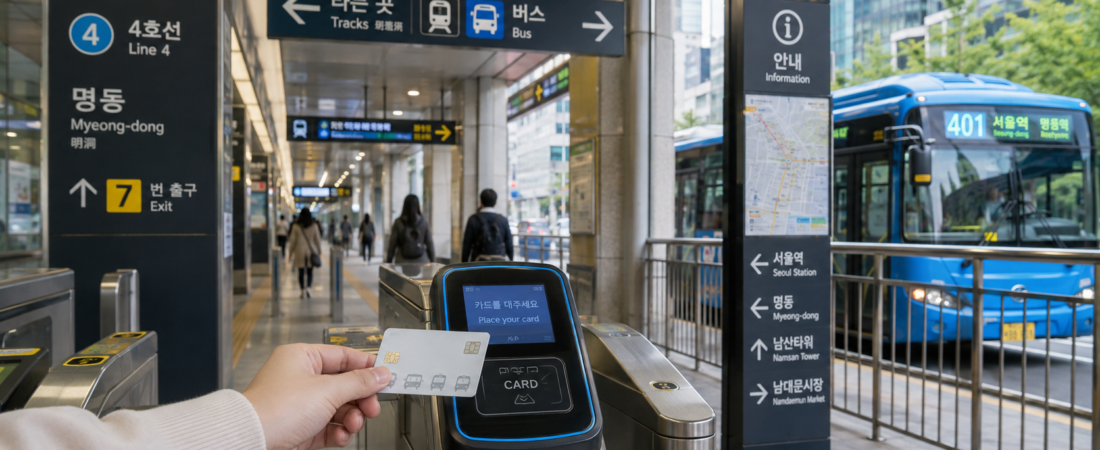
Using public transportation in Korea gets much easier once you separate two questions:
- Are you traveling within a city or between cities?
- Which transport mode fits that trip best?
For travel within a city, subway and city bus are the main public-transport options, with taxis providing a useful door-to-door alternative. For travel between cities, trains such as KTX and express or intercity buses are the main choices.
This article is the starting point. Once you know which mode fits your trip, use the detailed guide for the actual booking, boarding, payment, or transfer steps.
First decide: city travel or intercity travel?
For travel within a city, think mainly about:
- subway
- city bus
- taxi when a door-to-door option makes more sense
For travel between cities, think mainly about:
- train or KTX
- express or intercity bus
That distinction matters because the payment method, station or terminal, ticketing process, and route-planning steps can be very different.
There is no single mode that is always fastest, cheapest, or best. The right choice depends on the actual route.
When should you use the subway?
If you are in a city with a subway network, the subway is often useful for a straightforward rail-based trip across the city.
It is especially practical when your destination is close to a station and the route does not require an inconvenient detour.
Not every Korean city has a subway, so check the local transport network first.
For the full first-use process—gates, direction, transfers, exits, and wrong-way recovery—see How to Use the Subway in Korea.
When should you use a city bus?
City buses are useful for local areas and neighborhoods that are not directly reached by rail.
They can also fill the gap between a subway station and a destination farther away.
Bus routes depend more heavily on the exact stop and direction, so route planning is especially important.
For the actual boarding process, stop bell, alighting tap, and missed-stop recovery, see How to Use a Bus in Korea.
When does a taxi make sense?
A taxi can be useful when you want door-to-door travel, are carrying heavy luggage, are going somewhere inconvenient by subway or bus, or need a practical fallback in an unfamiliar area or later in the day.
Taxis are not automatically faster or cheaper than subway or bus travel.
Treat them as another transport option rather than the default for every trip.
For the full first-use taxi process, see How to Take a Taxi in Korea
What about travel between cities?
For longer city-to-city travel, compare train/KTX with express or intercity bus.
Train or KTX can be a strong option between major cities connected by rail.
Express and intercity buses are also important because they serve many destinations that are not directly reached by rail, including smaller cities and towns.
The better option depends on the actual route, departure point, arrival point, schedule, and destination.
For train-specific booking and boarding, see How to Take the KTX in Korea.
For terminal choice, ticketing, and long-distance bus procedure, see How to Take Intercity and Express Buses in Korea.
Do you need a transportation card?
For routine subway and city-bus travel, a prepaid transportation card such as Tmoney is a practical default.
It is widely used for local transit, but it is not a universal payment card for every transport service in Korea.
The same card should not be assumed to cover every train, long-distance bus, taxi, or other service in exactly the same way.
For buying, loading, using, refunding, and managing a standard physical Tmoney card, see How to Buy and Use a Tmoney Card in Korea.
Plan the route before you start
Before your first ride, check:
- your starting point
- your exact destination
- the route
- any transfer
- the direction
- the last service if you are traveling late
Public-transit route search is available through major Korean map services and official tourism tools.
You do not need one specific app. Check the route before you start rather than trying to solve every step after boarding.
Saving the exact destination—and the Korean place name or address when useful—can also help you match local signs or show the destination to staff or a driver.
What should you know about transfers?
Transfers are a normal part of urban public transportation in Korea.
A transportation card can be important for transfer and fare processing, but the exact time window, number of transfers, and fare rules vary by city.
A Seoul transfer rule should not be treated as a nationwide rule.
For a first trip, the practical approach is to check the transfer in your route before starting and follow the local system’s tagging instructions.
What should you prepare before your first ride?
For most first-time visitors, a simple preparation checklist is enough:
- know whether the trip is local or intercity
- choose the likely mode
- have the correct ticket, payment method, or transportation card
- save the route and destination
- check transfers and direction
- check the last service if traveling late
- keep a small cash backup only if your planned payment or Tmoney top-up requires it
You do not need to learn every Korean transport rule before your first trip.
Start with the mode that fits the journey, then use the detailed guide for that specific system.